
Best Logos Bible Study Alternatives in 2026
By Sankalp Jonna · Last reviewed 2026-05
How we tested
Every app here was installed and used personally. We capture raw findings — typed notes, screenshots, screen recordings, voice memos — and the writing is AI-assisted from those raw notes. Scores, rankings, and "best for / skip if" calls reflect our actual experience with each app. Read the full methodology →
Why people leave Logos Bible Study
- Subscription pricing fatigue — Premium ($9.99/mo), Pro ($14.99/mo), and Max ($24.99/mo) on top of the base-package model creates a 'how much is this really costing me' problem.
- Base packages range $294.99 one-time at the entry level to $10,799.99 at the academic Diamond/Portfolio tier, and the path to a strong library still costs hundreds to low-thousands.
- Pricing is genuinely confusing — base packages, subscription tiers, individual book purchases, and frequent sales make it hard to know what you actually need.
- Steep learning curve on every platform — most users use about 10% of what Logos can do.
- Faithlife ecosystem (Sermons, Equip, Proclaim, Connect) is sprawling, and the cross-product upsell is constant inside the app.
- Mobile performance can stutter on older phones once a library passes a few hundred resources, especially compared to Accordance on Apple Silicon.
Side-by-side comparison
Pricing and feature snapshot across 6 alternatives.
| Feature | Logos | Accordance | Olive Tree | Blue Letter Bible | Bible Gateway | ESV Bible |
|---|---|---|---|---|---|---|
| Free tier | Free tier; full access via paid subscription | Free tier; optional in-app purchases | Free tier; full access via paid subscription | Fully free, no ads | Free tier; full access via paid subscription | Free tier; optional in-app purchases |
| Annual price | $4.99/mo (no annual) | $0 | $2.99/mo (no annual) | $0 | $69.99/yr | $0 |
| Pricing model | Subscription + base packages + add-ons | One-time ownership | Both (Plus subscription or one-time) | Donor-funded, free | Subscription | Free + one-time resource purchases |
| Mac-native experience | Yes (universal binary, mature) | Yes (Mac-first, Apple Silicon-optimized) | Yes (Mac sync via desktop client) | Web-based on Mac | Web-based on Mac | Web-based on Mac |
| Original-language tools | Yes (deepest — syntax trees, semantic-domain searches) | Yes (research-grade Greek/Hebrew/Aramaic) | Yes (Strong's, interlinears, lexicons) | Yes (Strong's, lexicons, interlinears) | No | No |
| Commentary library | Yes (largest catalog) | Yes (smaller than Logos but deep) | Yes (Plus library + purchasable) | Yes (public-domain — Matthew Henry, JFB, Gill, Clarke) | Yes (NIV Study, MacArthur, Believer's, etc.) | Yes (ESV Study, MacArthur, etc. as purchases) |
| Sermon prep / pastor tools | Yes (Sermon Builder, Factbook, Passage Guide) | Limited | Limited | No | No | No |
| AI Bible chat | Yes (grounded in your library) | No | No | No | No | No |
| Mobile app quality | Strong (caught up to desktop) | Weaker — feels like a companion to desktop | Strong (split-window, real notes) | Lean and fast, dated UI | Functional, lags web | Excellent typography |
| Resource ownership | Yes for purchased books, no for subscription content | Yes — permanent license | Yes for purchased books | N/A (free) | No (subscription) | Yes for purchased resources |
| Theological advisors named | Faithlife scholars | Accordance editorial board | HarperCollins Christian Publishing | Donor-funded ministry | HarperCollins Christian Publishing | Crossway editorial board |
Logos Bible Study alternatives
Ranked by what we'd actually recommend after using each.
Accordance Bible Software
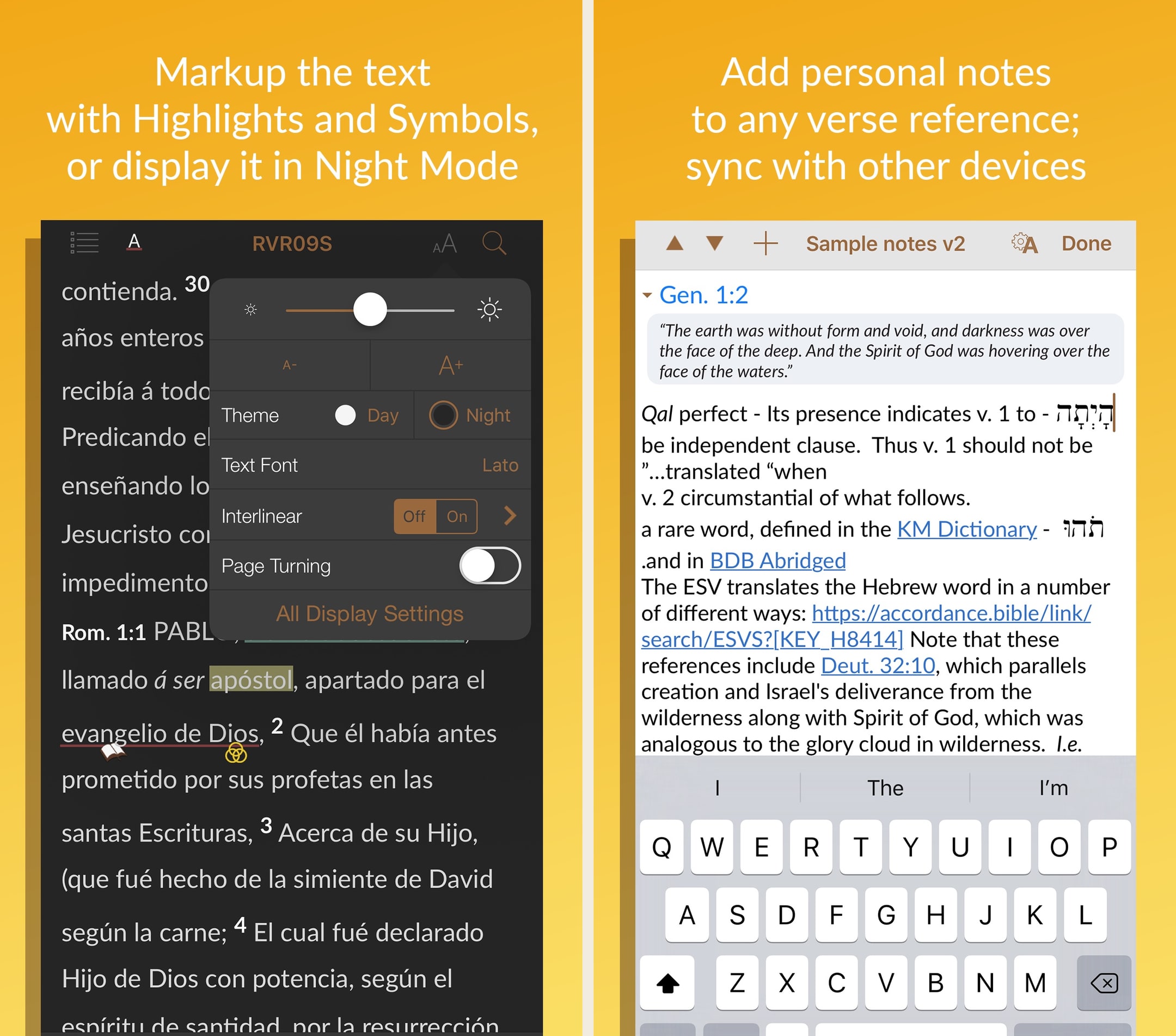
Accordance is the Mac-first ownership-model alternative to Logos that has been the quiet pick for serious scholars for decades. The $49 starter license is a permanent software license with a real starter library — no subscription required to keep using your library. Search speed across a heavy library is visibly faster than Logos on Apple Silicon, and the cleaner UI matters for long study sessions.
Pick this if: You're on a Mac, you want a one-time-purchase platform you actually own, and you'll buy resources targeted to your study rather than rent a sprawling subscription library.
Olive Tree Bible
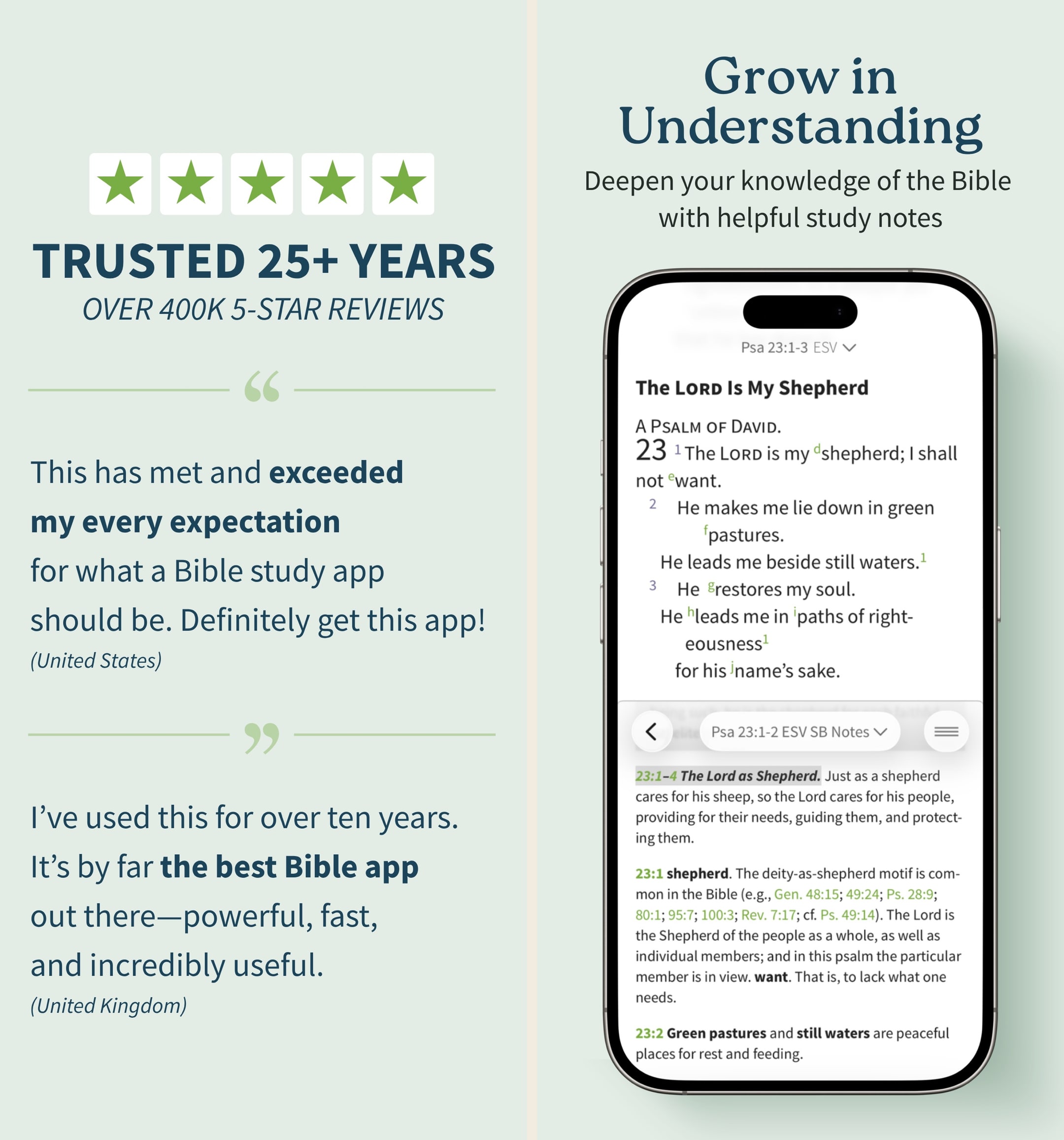
Olive Tree is the cleanest middle path between YouVersion casual reading and Logos research-grade study. Split-window reading on a phone is the single best small-screen study feature on any Bible app, the notes are real long-form notes (taggable, syncs across iPhone/iPad/Mac/Windows), and you can buy individual study Bibles and commentaries one-time without a subscription.
Pick this if: You want serious study tools on phone and laptop without Logos pricing or learning curve, and you'd rather own resources outright than commit to a monthly tier.
Blue Letter Bible
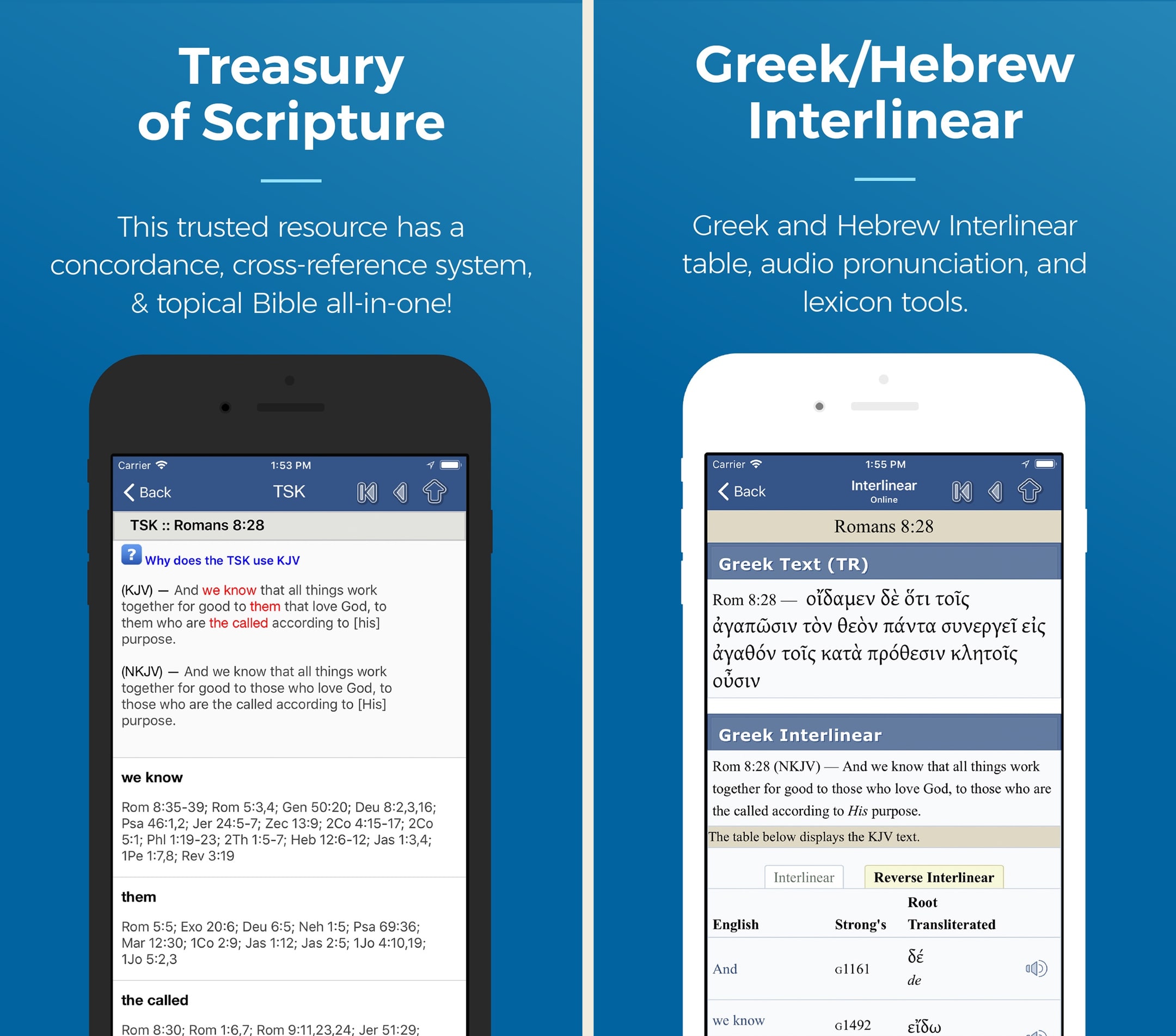
Blue Letter Bible is the best free original-language tool on a phone — tap any word, see Strong's, lexicon entry, every other place that root appears in scripture, all for $0. Treasury of Scripture Knowledge cross-references built in, public-domain commentaries (Matthew Henry, JFB, Gill, Clarke) integrated. Donor-funded, no premium tier, no ads.
Pick this if: You want serious word-study tools without paying anything and you can live with a UI that looks like a 2017 study tool — and you don't need the modern study Bibles Logos ships.
Bible Gateway
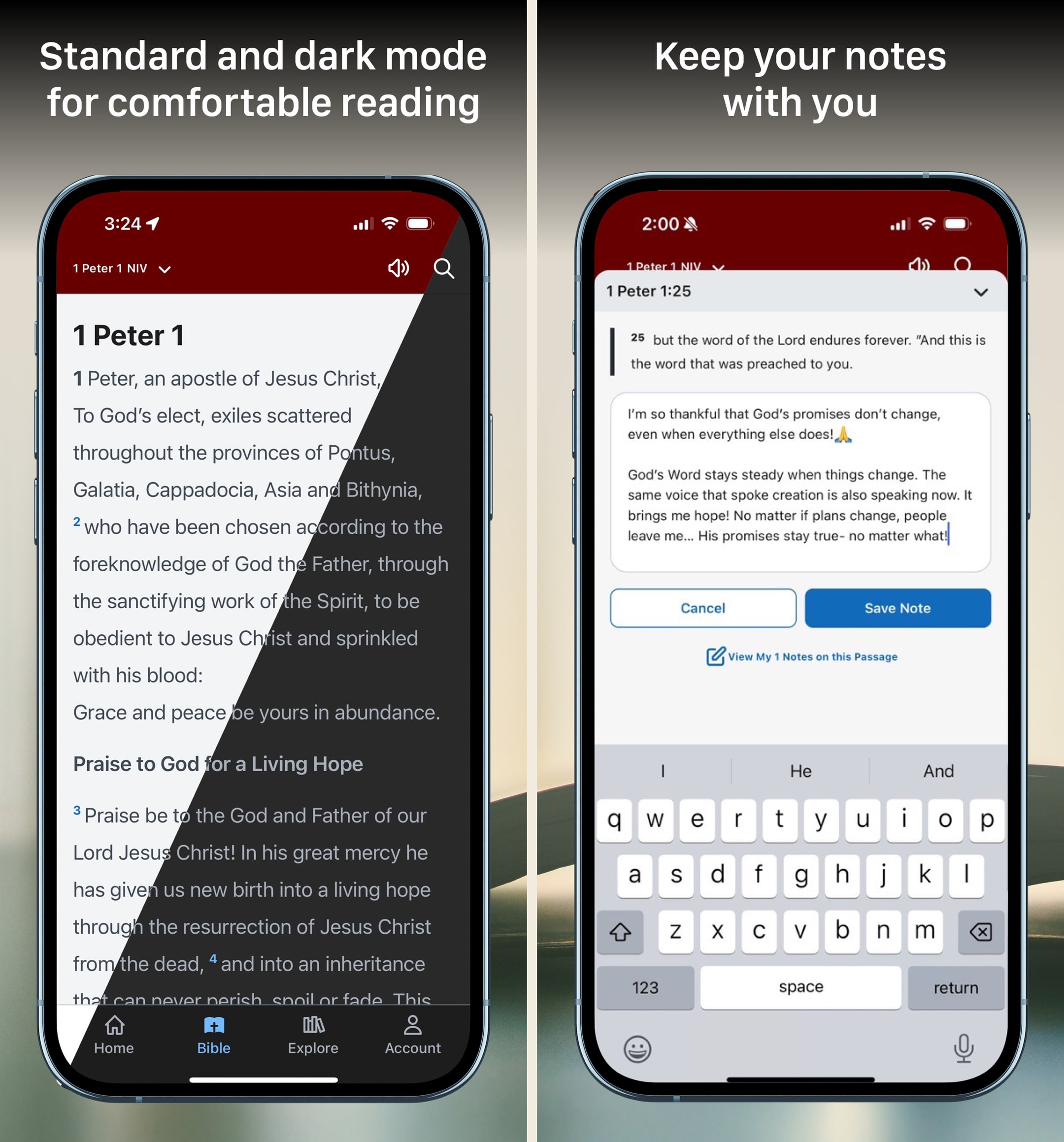
Bible Gateway Plus at $69.99/year is the cheapest legitimate path to a real digital study-Bible-and-commentary library — NIV Study Bible, MacArthur Study Bible, Believer's Commentary, and more. Free tier ships 200+ translations and 30+ audio Bibles. The app is most useful when paired with the website, where most heavy reading happens.
Pick this if: You don't need original-language tools or sermon-prep features, you mostly want named study Bibles and major commentaries on your phone, and you want to spend $5.83/month rather than $12.50/month for Logos Pro.
ESV Bible
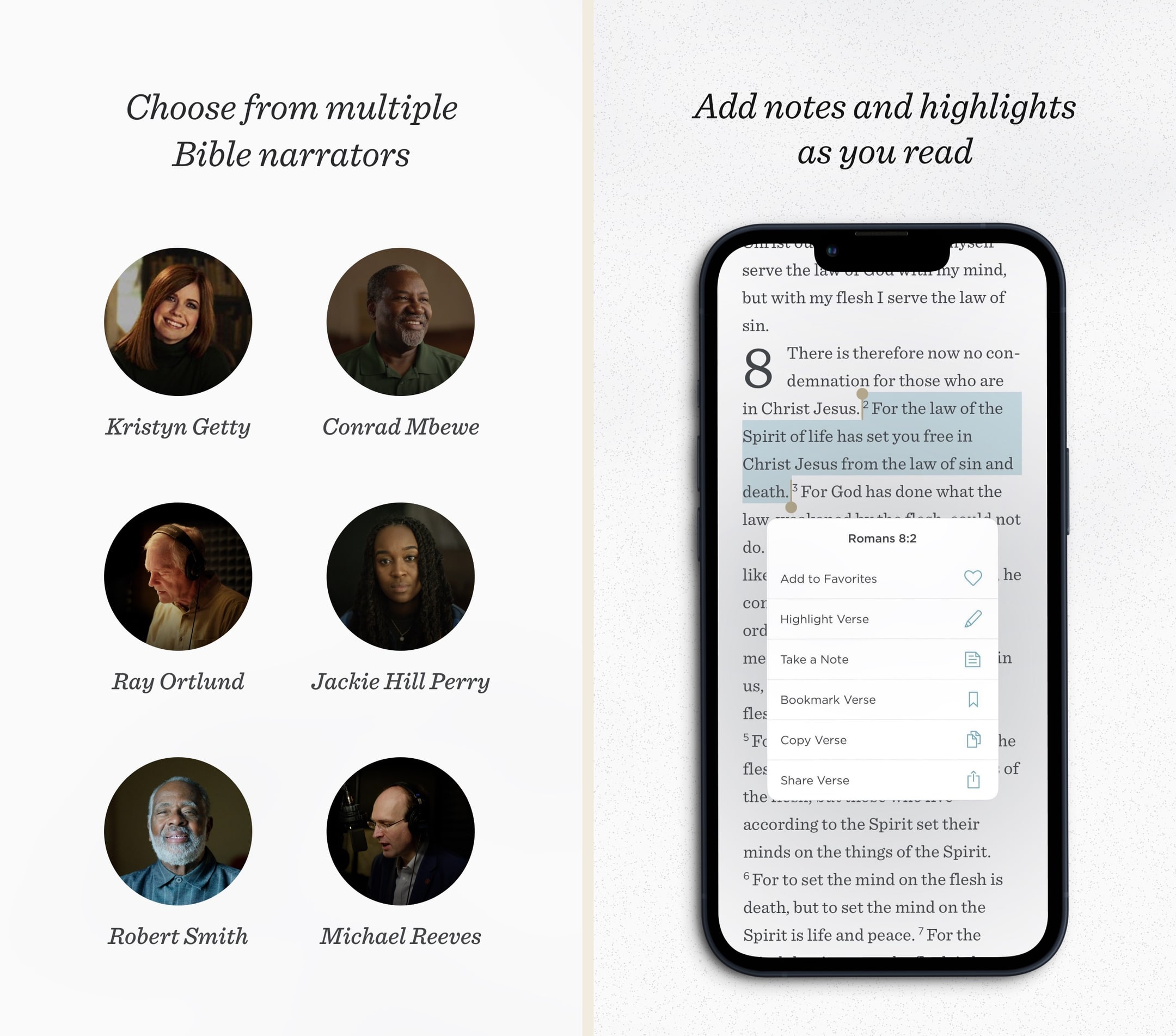
Crossway's ESV app has the best typography of any Bible app on iPhone, and the in-app purchase model lets you add the full ESV Study Bible, MacArthur Study Bible, or Reformation Study Bible without committing to a Logos subscription. Reading plans are curated by named teachers (Jen Wilkin, Paul Tripp, Kevin DeYoung, Nancy Guthrie). Free streaming audio for the entire Bible.
Pick this if: You read the ESV, you want a quiet single-translation reading app, and you'll buy specific study Bibles individually rather than committing to a research platform.
Coming soon
Waitlist now
Warmpeach (upcoming)
Warmpeach is not a Logos replacement and we want to be honest about that. Logos is a research-grade study platform; Warmpeach is being designed as a chat-style daily reflection tool. They're different categories. We're building Warmpeach for the conversational reflection layer that none of the heavy study apps are designed to be — pastor- and therapist-style guidance with crisis resources surfaced by default, named advisors, and pricing that doesn't compound against the user. Currently waitlist-only.
Pick this if: You want to keep Logos for serious study and pair it with a chat-style reflection surface for daily devotional time — and you're willing to wait for Warmpeach to leave the waitlist.
What Logos does well
Where Logos falls short
How we tested the alternatives
Pricing comparison across alternatives
Who should stay with Logos
Verdict
Who this guide is for
If you're searching for Logos alternatives, you're probably in one of three buckets. The first is subscription fatigue: the $9.99/$14.99/$24.99 monthly tiers, on top of an existing base package, finally added up to a 'how much am I really spending on Bible software' moment.¹ The second is ownership: you'd rather buy a study Bible once and keep it forever than rent it monthly. The third is the platform fit — Mac users who've noticed Accordance is faster, mobile-first users who don't need the desktop ecosystem, or casual readers who realized they're paying for capability they'll never use.
We've used Logos daily for serious study alongside every meaningful alternative on iOS, Mac, and Windows. This guide is the result.
What to look for in a Logos alternative
A pricing model you can defend in your head
Logos's tier sprawl is the headline problem for a lot of users. Subscriptions stack on top of base packages, individual book purchases stack on top of subscriptions, and frequent sales make it hard to know what you actually need.¹ Accordance's $49 starter license is the cleanest counter — pay once, own the software, buy resources targeted to your study.² Olive Tree's hybrid model (Plus subscription or one-time resource purchases) is the second cleanest.³
Mac-native performance
If you're a Mac user with a heavy library, Accordance is faster than Logos on Apple Silicon. Search across thousands of resources runs visibly quicker, and the cleaner UI matters when you're in study sessions for an hour.⁴ Logos's Mac client is mature but slower under load. For Windows users, Logos is the better fit; Accordance's Windows client is functional but not the star.
Original-language tools
Logos's syntax trees, semantic-domain searches, and morphological datasets are unmatched.¹ If you don't need that depth — if 'tap a word, see Strong's, see lexicon, see every other place that root appears in scripture' is enough — Blue Letter Bible does that for free, and Olive Tree's Plus tier covers it for $59.99/year.⁵³ Accordance's original-language tools are research-grade but a smaller catalog than Logos.²
Sermon prep workflows
This is the place we'd actually stay with Logos. Sermon Builder, the lectionary integration, and the Passage Guide together are genuinely weekly software for working pastors.¹ None of the alternatives ship an equivalent. If you preach regularly, Logos Pro at $149.99/year is fair value and we wouldn't switch.
Whether you actually wanted a different category
If what you used Logos for was reading, not research, you're paying for capability you'll never use. The ESV Bible app's typography is better than Logos's reading view, Olive Tree's split-window beats Logos for two-translation comparison on a phone,³ and Bible Gateway Plus at $69.99/year ships the major study Bibles for less than half the Logos Pro price.⁶
The honest tradeoffs
Every alternative in this guide has a real downside.
Accordance
Mac-first, ownership-model, fast. The mobile apps are noticeably weaker than the desktop experience — the iPhone app feels like a companion, not a full client. Resource catalog is smaller than Logos; some niche academic resources just aren't available. The marketing site and store experience are dated.
Olive Tree
The cleanest middle path between casual reading and serious study. Split-window reading is the best small-screen study feature on any Bible app, and the notes are real. The store is overwhelming and the UI is dated; building a serious paid library can run several hundred dollars even on sale.
Blue Letter Bible
Best free original-language tools on a phone. UI is utilitarian and looks like a study tool from 2017. Modern translations are limited, and there's no community or reading-plan polish. Donor-funded, no ads.
Bible Gateway
The cheapest legitimate path to a real study-Bible-and-commentary library at $69.99/year.⁶ Free tier is solid for daily reading. Offline mode is weak — the app really wants a connection — and there are no original-language tools at all, even on Plus.
ESV Bible
The most beautifully typeset Bible reading experience on iPhone.⁷ Single translation by design, theological lean is unmistakably Reformed/complementarian, and original-language tools are absent. The free tier alone is more than most paid apps offer.
What we'd do
For most readers leaving Logos, the cleanest move depends on what you actually do. If you preach, stay with Logos Pro at $149.99/year — Sermon Builder is the deciding feature. If you study seriously on a Mac, Accordance ($49 starter + targeted resources) is meaningfully faster and you own what you buy. If you study on a phone, Olive Tree Plus at $59.99/year is the cleanest path and the notebook is real. If you want free original-language tools, Blue Letter Bible. If you want named study Bibles at the cheapest legitimate price, Bible Gateway Plus.
If what you really wanted was a chat surface for daily reflection — not research, not sermon prep — that's a category Logos was never trying to be. Warmpeach is the product we're trying to build for that. It's not a Logos replacement; it's a different tool. Currently waitlist-only.
We're building one too
Warmpeach is a Bible chat app that blends a pastor's care with a therapist's questions, grounding every reply in scripture. We're building it for daily reflection rather than research-grade study. Warmpeach is not a Logos replacement; Logos is a different category of tool. Currently waitlist-only. We're not claiming Warmpeach will be the best at anything Logos does — we're trying to fill the chat-style reflection gap that no study platform is designed to be.
Warmpeach — coming soon
A Bible chat app — pastor and therapist in one.
Warmpeach is a Bible chat app that blends a pastor's care with a therapist's questions, grounding every reply in scripture. Join the waitlist and we'll email you when it opens up.
Sources
-
Logos Bible Study — App Store listing (Logos Standard/Pro/Max subscription tiers, base packages, Sermon Builder, Passage Guide). Accessed 2026-05-11. https://apps.apple.com/us/app/logos-deep-bible-study/id336400266
-
Accordance Bible Software — official site (starter license, ownership pricing). Accessed 2026-05-11. https://www.accordancebible.com/
-
Olive Tree Bible — App Store listing (Plus subscription, split-window reading, hybrid pricing model). Accessed 2026-05-11. https://apps.apple.com/us/app/bible-app-by-olive-tree/id332615624
-
Hands-on testing notes captured during 2026-05 — Logos vs Accordance Mac performance comparison on Apple Silicon. Raw screenshots in our internal archive.
-
Blue Letter Bible — App Store listing (free, Strong's, lexicons, interlinears). Accessed 2026-05-11. https://apps.apple.com/us/app/blue-letter-bible/id365547505
-
Bible Gateway — App Store listing (Plus annual $69.99, study Bibles, commentaries). Accessed 2026-05-11. https://apps.apple.com/us/app/bible-gateway/id506512797
-
ESV Bible — App Store listing (Crossway, Global Study Bible, optional in-app study Bibles). Accessed 2026-05-11. https://apps.apple.com/us/app/esv-bible/id361797273