
Blue Letter Bible vs Logos: A Head-to-Head for 2026
By Sankalp Jonna · Last reviewed 2026-05
How we tested
Every app here was installed and used personally. We capture raw findings — typed notes, screenshots, screen recordings, voice memos — and the writing is AI-assisted from those raw notes. Scores, rankings, and "best for / skip if" calls reflect our actual experience with each app. Read the full methodology →
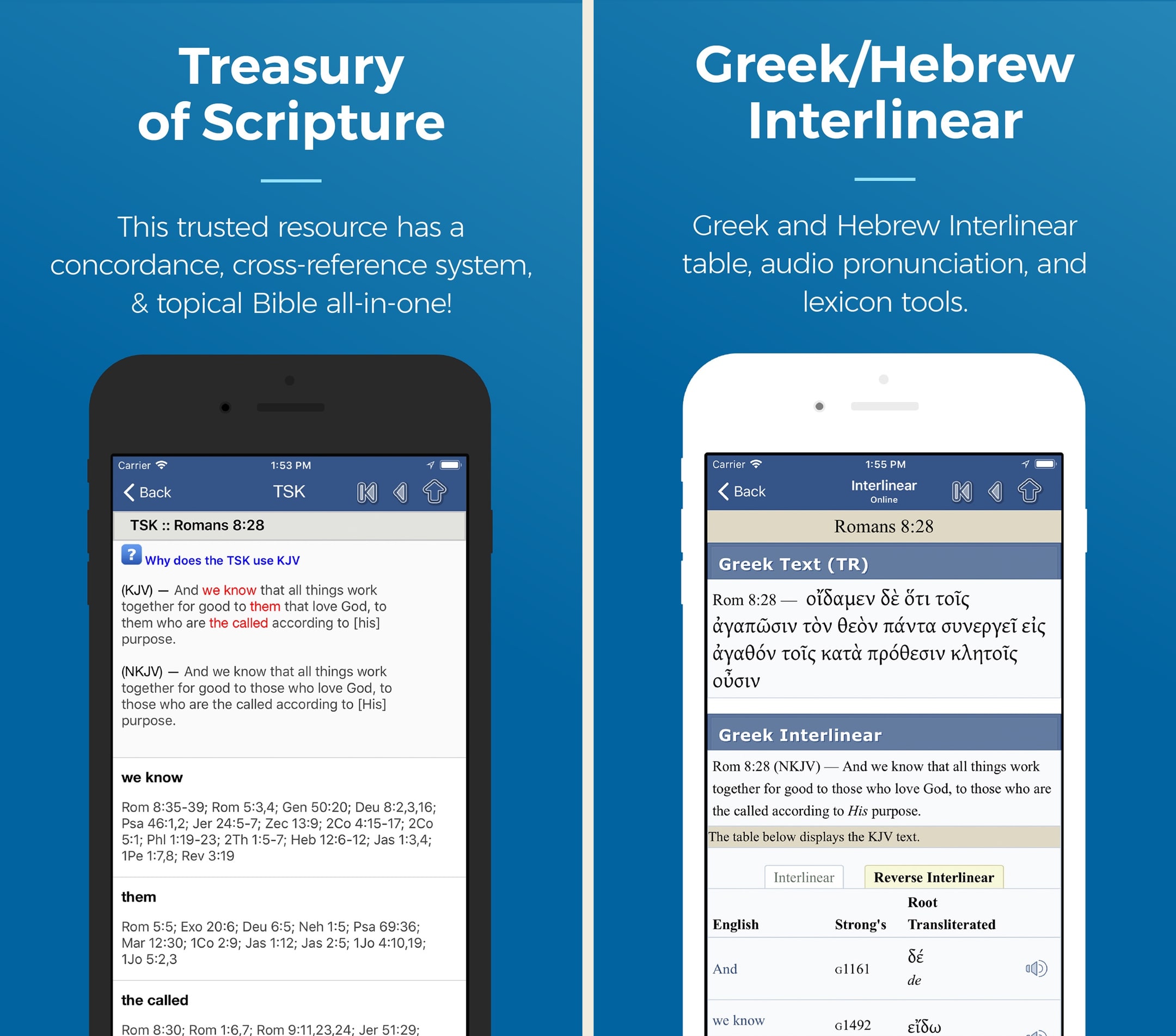
Blue Letter Bible
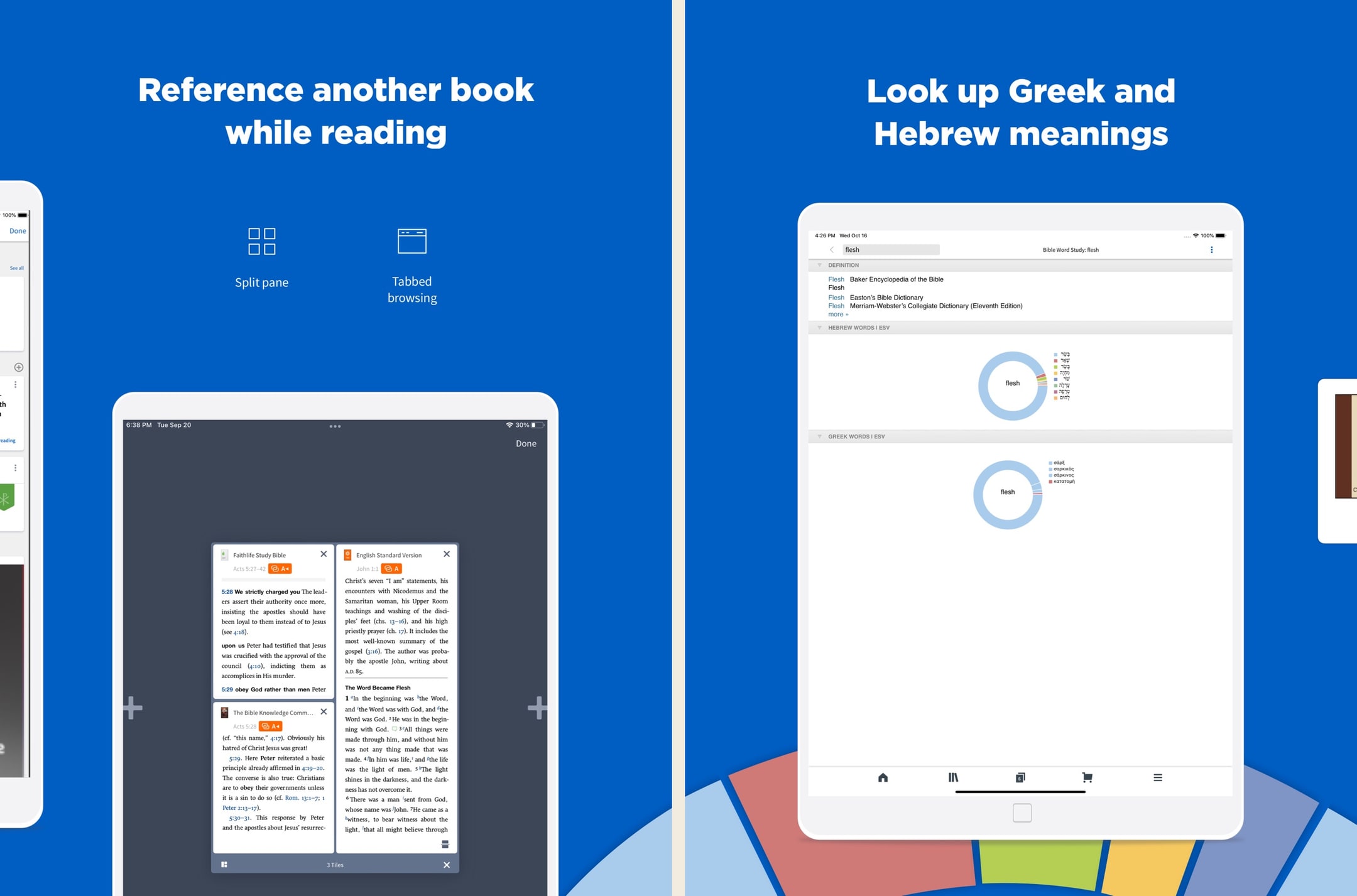
Logos Bible Study
Quick verdict
Choose Blue Letter Bible if
- Your budget is $0 and you want a serious study tool that doesn't paywall any feature.
- You're a serious lay student or small-group leader doing word-study work, not academic research.
- You read mostly older or public-domain commentaries (Matthew Henry, Jamieson-Fausset-Brown, Gill, Clarke) and don't need the latest copyrighted scholarship.
- You appreciate that Blue Letter Bible is donor-funded, has no premium tier, and is the same tool for every user.
- You want a Bible-study tool that's quiet, focused, and doesn't try to upsell you into an ecosystem.
Choose Logos Bible Study if
- You preach, teach, or write professionally and your work demands modern copyrighted commentaries Blue Letter Bible doesn't carry.
- You need research-grade original-language tools — morphological searches, syntax trees, semantic-domain queries.
- You want AI study features grounded in a real commentary library.
- You're already a serious user who's outgrown the free tools and is ready to invest in a permanent professional library.
- Your weekly sermon prep or research workflow justifies the $9.99-$24.99/month subscription or one-time base package.
Side-by-side
Feature-by-feature, the way we'd lay it out at a kitchen table.
| Feature | Blue Letter Bible | Logos Bible Study |
|---|---|---|
| Pricing | $0 forever | Free + $4.99/mo Premium |
| Free tier reality | Fully free, no ads | Free tier; full access via paid subscription |
| Original-language tools | Strong's, lexicons, every-occurrence search — for free | Research-grade — morphology, syntax trees, semantic-domain searches |
| Commentaries | Public-domain only (Matthew Henry, JFB, Gill, Clarke) | Thousands available — modern, academic, denominational, niche |
| AI features | None | Logos AI assistant grounded in your library |
| Translations | KJV, NASB, ESV (limited), and a handful of others | Most major translations plus academic critical editions |
| Cross-references | Treasury of Scripture Knowledge built in and crosslinked | Multiple cross-reference sets, including academic |
| Mobile experience | Lean, fast, offline-capable, no account required | Improving but still desktop-first |
| Sermon-prep workflow | Manual — works but slower | Passage Guide and Sermon Builder compress an hour into minutes |
| Best-fit reader | Serious lay students, small-group leaders, $0-budget readers | Working pastors, seminary students, professional teachers |
Setup & onboarding
Core features
Pricing breakdown
Support & community
Mobile experience
Verdict
Warmpeach — coming soon
Join the Bible chat app waitlist
Why this comparison comes up
Anyone who gets serious about Bible study eventually asks the same question: do I really need to pay for Logos, or can I do this for free? The honest answer is "it depends on what 'serious' means for you" — and that's why Blue Letter Bible vs Logos is one of the most useful comparisons in the category.
Blue Letter Bible is the free, donor-funded study tool that has quietly served lay readers, small-group leaders, and budget-conscious pastors for decades.¹ It's not a polished consumer app; it's a genuinely useful Bible-study workbench that costs nothing. Logos is the paid platform working pastors and seminary students use when their work outgrows the free tools — modern commentaries, research-grade original languages, AI features, all behind a subscription that runs $9.99-$24.99/month plus base packages from $294.99 to $10,799.99.²
The reason this comparison matters: a lot of users assume they need Logos because it's the "real" Bible study app, when in fact Blue Letter Bible covers their actual workflow at $0. And a smaller but important group of users tries to do Logos-grade work in Blue Letter Bible and gets stuck at the limits of public-domain commentaries.
The buyer profile
The Blue Letter Bible buyer (well, user — there's nothing to buy) is a serious lay student, a small-group leader, a budget-conscious pastor, or a returning reader who wants real word-study tools without paying for them. They're comfortable with a utilitarian UI, they value the donor-funded ministry model, and their study workflow is mostly word study, cross-references, and public-domain commentary.
The Logos buyer is a working pastor, a seminary student, a professional teacher, or a serious lay student who has outgrown the free tools and is ready to invest in a permanent professional library. They need modern copyrighted commentaries, research-grade original-language tools, sermon-prep workflows, and (increasingly) AI features grounded in a real library. They're comfortable with the cost because the time saved across hundreds of weeks of work justifies the spend.
The 70/30 question
The most useful framing we've found: Blue Letter Bible covers about 70% of the typical Bible-study workflow. Word study, lexicons, every-occurrence search, public-domain commentary, cross-references — all genuinely covered, all free. Logos covers the remaining 30% that professional users need: modern commentaries (NICOT, NICNT, BECNT, etc.), syntactic and semantic-domain searches, sermon-prep workflows, AI assistance. The question isn't which is better; it's whether you need the 30% Blue Letter Bible doesn't cover.
For most serious lay students, the answer is no, and Blue Letter Bible is the right answer forever. For most working pastors, the answer is yes, and Logos is worth the cost.
What stuck with us in actual use
Two things stuck after several weeks running both.
First: Blue Letter Bible's Strong's-and-lexicon workflow is shockingly competitive at $0. Tap a word, get the Greek or Hebrew, see every place that root appears in scripture, read the lexicon entry — and pair that with Treasury of Scripture Knowledge cross-references and four serious public-domain commentaries — and you've got a real Bible-study tool.³ It's not pretty, but it works, and for many users this is enough.
Second: Logos's Passage Guide and AI assistant are exactly the workflows Blue Letter Bible can't replicate. Click a passage, get a research dossier in seconds — modern commentary excerpts, original-language data, related Factbook entries. Ask the AI a research question and get an answer grounded in your library. These workflows are why working pastors pay for Logos, and they're not something you can fake with free tools.
The honest cost picture
The most expensive thing about Logos isn't the subscription — it's the assumption that you need it. Many users buy Logos because it's the "professional" choice, then use about 5% of what it does and stop opening it. If your weekly Bible study is reading scripture, looking up a Greek word, and reading a commentary, Blue Letter Bible covers all of that for $0 and you're paying $200/year or more for nothing.
The right test: try Blue Letter Bible for a month and see what workflows it can't support. If you hit real walls — needing a modern commentary it doesn't have, needing morphological searches it doesn't support — then Logos is the right next step. If you don't hit walls, Logos isn't the missing piece.
The free-tier honesty
Logos has a free tier, technically. Install the app, get a small starter library, see what the platform looks like. But calling Logos's free tier "free" the way Blue Letter Bible is free is misleading. Logos's free tier is a sample; Blue Letter Bible's free tier is the entire product. If you want serious study tools at $0 indefinitely, Blue Letter Bible is the only credible option of these two.
The complementary stack
The pattern that actually works for many serious users: Blue Letter Bible on the phone, Logos on the laptop. BLB covers quick word lookups during conversations, sermons, or commute reading; Logos covers the heavier sermon-prep and research work that happens at a desk. Because BLB is free, there's no real cost to running both — you just install it and use it as needed.
When to pick which
Pick Blue Letter Bible if your budget is $0, your work is serious-lay-student rather than professional teaching, and your study time is word study and public-domain commentary. It's a real tool, it's free forever, and for most users it's enough.
Pick Logos if you preach, teach, or write professionally, your work demands modern commentaries and research-grade tools, and you're ready to invest $400-1,200+ in a permanent library. The 30% that Blue Letter Bible doesn't cover is exactly the 30% professional users need.
If you're not sure which you are, start with Blue Letter Bible and see whether you hit its walls. If you do, upgrade. If you don't, save the money.
What real users say
Real-user reviews
This is the ultimate bible online study
Totally awesome! and without ads :This is Tremendous bible resource in every way, just start exploring and be sure to click on a verse and click the one in the middle of menu and you will be able view Greek and Hebrew and explanation of all words (that choice is: Concordance/Interlinear); and so much more, all ad free. It is truly amazing. I started using this app over 7 years ago. The desktop edition is also great. For this app:They keep improving on what is already great. Example: choice for you to have the chapter read aloud for you, or the whole of the book within the 66 books of the Bible. Just about every translation of the many English translations are available. Also includes Thayer’s in depth original and amazing words in Bible I continue to learn about the root meanings through this tremendous resource that the brilliant geniuses of the development team make available when you go to a verse in linear concordance and tap any word you will get Hebrew and Greek of word it even pronounces it for you and click at bottom of that page for the Thayer selection which opens up a whole realm of authentic text Insight- when you see it you’ll get what I mean - hard to describe depths of this and for each word. I’m not an employee of this remarkable non profit, may I recommend supporting it. Also fully available on your web browser. iPad version is also dynamic and outstanding as well.
— blueBibleReader
ONE Bible App to rule them all!
This is the most versatile Bible app I’ve ever tried. I had several before, but this one has replaced all of them. I can’t possible list all the features here, but I’ll list a few. It’s VERY customizable. You can turn Red Letter (on/off), you can toggle between single column or double column. And you can toggle parallel view off or on, when you need to compare translations. If you just want to do straight READING, for pleasure, you can select which options you want turned off… chapters, verses, paragraph markers, footnote markers, headings (aka: periscope), etc, which allows you to read the Bible like a novel. As for translations, there’s a lot! And you can choose as many or few as you want downloaded. For scholars, they even have five different Greek Septuagints (XXL) including the Textus Receptus, Byzantine, and others. and I just read that a recent update added an ENGLISH translation of the Septuagint (Brenton’s BES), so I’m excited to have an Eng vers. (I haven’t actually seen it yet, but it was mentioned in the release notes) I could go on forever, but I wanted to keep this short, so that’s all for now. I’ll update again if other features get added that are noteworthy enough to mention here. Bottom line: Five HUGE stars! ⭐️⭐️⭐️⭐️⭐️ UPDATE: the release notes say that Brenton’s English Septuagint was added, but when I open the translations selections, Brenton’s Septuagint is not there! Attention DEVS, is that a bug? Why is it not in the list of available translations?
— Vmurp
Real-user reviews
I love this app.
I have used many Bible apps and software and when by the grace of God I was led to the Logos web site, I was like a kid in a candy store with the permission to eat anything I wanted. I still keep the other Bible software but primarily I use Logos and the more resources you purchase the more powerful your Bible software becomes you only need to purchase what you need, I am just a lay person some of the packages I can't use at the present time. I think that any investment into The things concerning God is prosperous. To whom it may concern I hope anything that I say being just a lay person who is still reaping the benefits of what I don’t deserve which is to walk in the spirit of God and stumbling, falling and bouncing off the walls , if you will, and still reaching and walking after the perfection and that perfection being Christ. So this is my second time writing a review for this. I can barely find the words most glorious I don’t know powerful Bible software that I know to date many preachers use it so all I got to say is I hope I’m understood because I am not erudite and speech, but there are no lies coming out of my mouth, I just love LOGOS though when I found out about it so many books, I haven’t even read yet by the grace of God I’m gonna spend my life in his service and his word praise be to God, peace and spiritual prosperity to all who read this, I said the spirit of Godand the spirit does not stay with you always which is why we have to keep walking after pray for you. You know what I’m talking about. I’m saying I’m not saying God.
— Hldavis7455
GO DEEPER
I am really impressed with the abilities the Logos software enables me to have. Notes on scriptures. Word meanings and their origins. The original Hebrew and its pronunciations. Bible word studies and word searches. Cutting my search time down immensely so I may study more in depth and for longer. I can discover more scriptures using words I want to understand more fully in the amount of time it takes me to type the word. I can even access a nightly devotion and never lose my place. I can do everything on my phone so I am always ready to show my friends. It’s not just for pastors. It’s not just for sermon writing. This allows me a deeper study with My Savior. This is education at my desk or in my pocket so His word is ever before me. It’s an app with easy to use tools for the layman that he too may explore his Bible more fully and ‘Knock’ at the door. Seek and you may find. This allows me to seek ever more deeply and quickly. As a mom of five, time to study is short. The ability to go from page to page and reference to reference quickly is important. The ability to use the app anywhere helps because you never know when you may get a free moment or the urge to seek understanding.
— Jgourle3
Warmpeach — coming soon
A Bible chat app — pastor and therapist in one.
Warmpeach is a Bible chat app that blends a pastor's care with a therapist's questions, grounding every reply in scripture. Join the waitlist and we'll email you when it opens up.
Sources
-
Blue Letter Bible — App Store listing (free, donor-funded). Accessed 2026-05-11. https://apps.apple.com/us/app/blue-letter-bible/id365547505
-
Logos Bible Study — App Store listing (subscription tiers, base packages). Accessed 2026-05-11. https://apps.apple.com/us/app/logos-deep-bible-study/id336400266
-
Hands-on testing notes captured during 2026-05 — Blue Letter Bible Strong's, lexicon, and TSK cross-reference workflow tested across multiple devices. Raw screenshots in our internal archive.