
Accordance Bible Software Review
By Sankalp Jonna · Last reviewed 2026-05
Get the app
How we tested
Every app here was installed and used personally. We capture raw findings — typed notes, screenshots, screen recordings, voice memos — and the writing is AI-assisted from those raw notes. Scores, rankings, and "best for / skip if" calls reflect our actual experience with each app. Read the full methodology →
Our verdict
We'd recommend Accordance for Mac-using pastors, scholars, and serious lay teachers who prefer one-time purchases over subscriptions and who do most of their study on a desktop. The $49 starter license is the cheapest legitimate path to a real ownership-model study Bible platform, and the Mac client is faster and cleaner than Logos for sustained search-heavy work on Apple Silicon. For users with a long horizon — meaning you expect to study seriously for the next decade — the ownership model is increasingly valuable as the rest of the industry moves toward subscriptions. Skip Accordance if you're mobile-first or if you want the absolute deepest catalog of academic resources. The iPhone and iPad apps are competent but noticeably thinner than the Mac client, and Logos still wins on breadth — especially in recent academic commentary series. Olive Tree at $59.99/year is the cheaper pick for most lay readers who don't need the depth of Mac-native original-language tools, and Blue Letter Bible is the free pick for Strong's-level word study. Accordance is what you choose when 'I want to own my library on a Mac' is non-negotiable.
Setup and first run
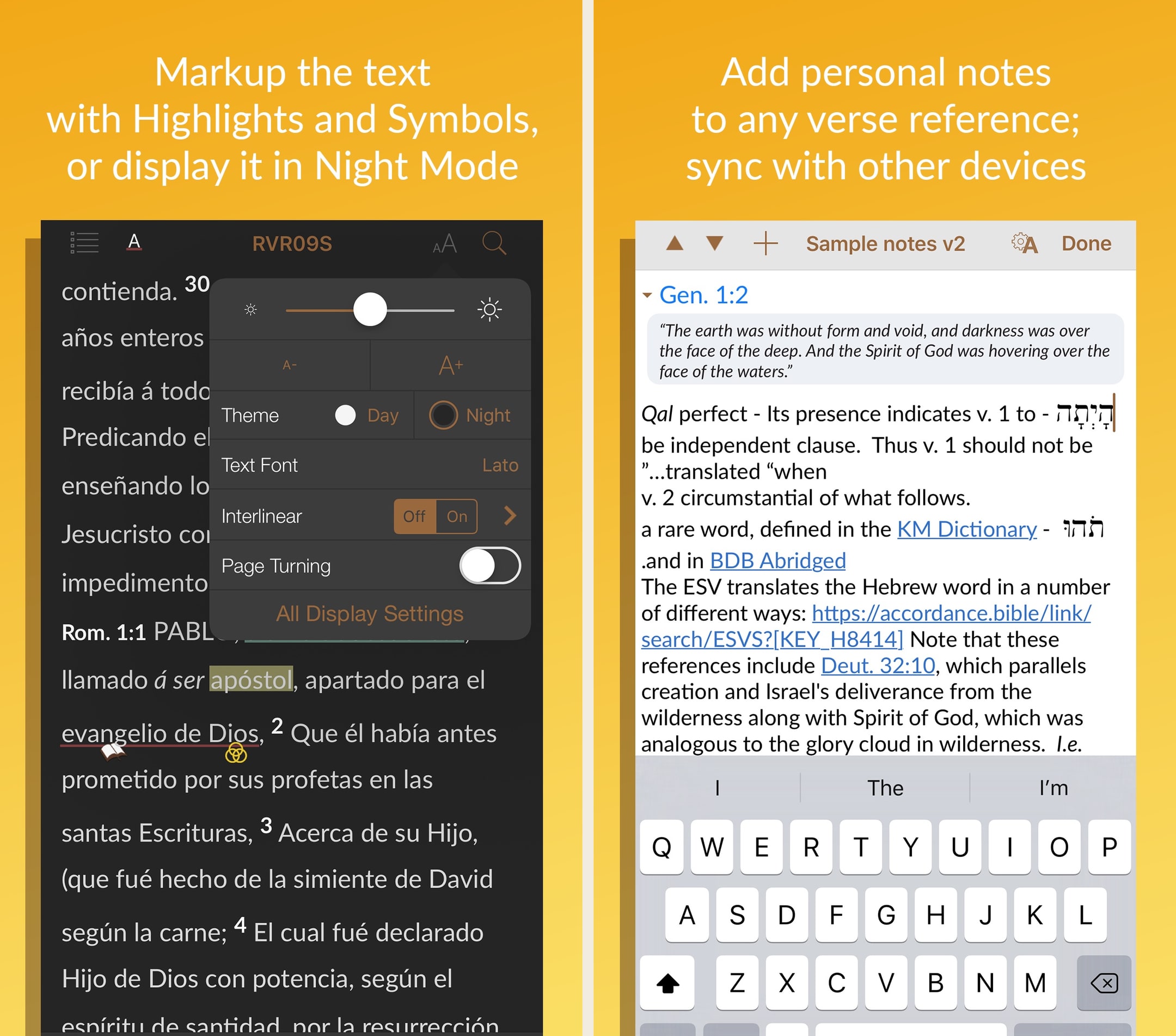
Installing Accordance on a Mac is closer to installing a piece of professional software than to a typical Bible app onboarding. We downloaded the Mac client, installed the 90-day free trial, and were taken through a short tour of the workspace, the resource manager, and the search syntax. The default workspace is a single text panel with a Bible loaded — utilitarian, fast, and ready for work.
The 90-day trial is the most generous evaluation window in the category, and it's the right way to evaluate. You get the full software plus 60+ trial resources (~$239 value) to use seriously for three months before deciding to commit.¹ We'd recommend treating the trial as a real test — load a real preaching text, run a real Greek search, build a notebook on a passage. Accordance reveals itself slowly; the first hour feels utilitarian, and the third week feels essential.
The mobile app is a separate install with the same account. The iPhone and iPad apps sync your library and notes from the Mac, but the heavy lifting clearly happens on the desktop. We set up the mobile apps mostly for casual reading and lookup; the serious work stayed on the Mac.
Day-to-day use
We used Accordance primarily for two jobs over multiple weeks: a Greek word study across the Pauline epistles, and a sustained study session on a single preaching text with notes and a commentary. Both jobs are exactly what the Mac client is built for.
Original-language searches
Accordance's morphological searches are research-grade in a way the consumer Bible apps aren't. We ran a search for "all participles modifying the subject of dikaioo in the Pauline epistles" — the kind of query that makes sense once you've taken Greek — and Accordance returned results in seconds, with morphological tags inline.² The same query on Logos took noticeably longer to run on the same Mac.² For sustained scholarly work, that performance gap compounds across an afternoon.
Sustained study sessions
The Accordance workspace is the cleanest sustained-study environment we've used. You can lay out parallel panels — Greek text, English text, lexicon, commentary — and they stay scroll-locked across passages. The interface is denser than Olive Tree's and cleaner than Logos's; there's no cross-product upsell creeping into the panels, no Sermon ad in the sidebar. For users who want to study without distraction, the absence of ecosystem noise is a real win.
Building a permanent library
We bought two targeted resources during testing — a study Bible and a commentary set — and the experience reinforced the ownership model. The resources downloaded once, integrated into the workspace permanently, and showed up on every device tied to the account. Two years from now, those books will still work the same way, with no subscription required. That's increasingly rare in the digital Bible world.
Where it surprised us
The performance gap on Apple Silicon was bigger than we'd expected. We'd assumed Accordance's "fast on Mac" reputation was historical — true ten years ago, possibly less true today as Logos has invested in its Mac client. In practice, on an M2 MacBook Pro, Accordance still runs original-language searches faster than Logos by a visible margin. For users who do scholarly work, the speed compounds across a study session in a way that matters.
The catalog turned out to be deeper than its reputation suggested. Yes, Logos has more SKUs overall — but for the resources serious lay studiers and most pastors actually use (study Bibles, major commentary sets, original-language lexicons), Accordance has the major options. The catalog gap is most visible in academic resources and very recent commentary releases; for working pastors and teachers, the gap rarely matters in practice.
The 90-day trial is genuinely generous. Most software gives you 14 or 30 days; Accordance gives you a full quarter to evaluate, with 60+ trial resources unlocked. That window is enough to use the software for two preaching cycles or a quarter of a seminary class — long enough to know whether it fits your workflow.
Where it disappointed
The mobile apps lag the desktop. The iPhone and iPad clients are competent for reading and casual lookup, but the heavy original-language work, sermon prep, and serious cross-references all feel like they're happening on the desktop. Logos has closed its mobile-vs-desktop gap more meaningfully in the last few years; Accordance hasn't made the same investment, and it shows. If you live on a phone, this isn't your pick.
The marketing site and store experience are dated. The website looks pre-2018, the store organization is hard to navigate, and the pricing across collection bundles is genuinely confusing without help. We'd recommend emailing Accordance support before any large purchase to confirm you're not duplicating resources you already own — they're responsive, but the store should make this easier.
The user community is smaller than Logos's. Fewer YouTube tutorials, fewer third-party guides, fewer Reddit threads with answers to specific questions. For experienced users who don't need community support, this doesn't matter; for new users still learning the platform, the smaller community means more figuring it out alone.
The catalog has notable gaps in recent academic commentary releases. If you're following the latest scholarship, Logos is still ahead. For most working pastors and lay teachers, the catalog is wide enough; for working biblical scholars at the cutting edge, Logos's catalog is the more honest answer.
The pricing reality
Accordance's pricing is the cleanest in the serious-study tier: $49 one-time for the starter license after a 90-day trial, plus individual resources from $10 to $1,000+ per book, with seasonal sales that meaningfully discount flagship sets.¹ There's no subscription, no monthly fee, no library you rent.
For most serious lay studiers, the realistic shape is $49 for the license plus $200–$500 for a few targeted resources over the first year. That gets you a usable permanent library that handles personal study and small-group teaching for a long horizon. For working pastors, expect $500–$2,000 in resource purchases over time, depending on tradition and the depth you want.
Compared with Logos Pro at $149.99/year,³ the math eventually favors Accordance for users who commit to the platform for a decade. Over ten years, Logos Pro costs ~$1,500 in subscriptions; Accordance with comparable resources can be roughly equivalent or cheaper, with the books permanently owned. The catch is the up-front commitment — Accordance requires you to be confident you'll keep using it long enough for the math to work.
All paid plans visible on the Accordance Bible Software App Store listing. Free trials and intro pricing may vary by region.
One-time
- New Living Translation-Second Edition$14.99
- Amplified Bible$14.99
- The Message$14.99
- Tanakh (The Jewish Bible) with Strong's numbers$19.99
- New King James Version (NKJV)$19.99
- New Revised Standard Version (NRSV)$19.99
- The Mounce Reverse-Interlinear New Testament and Dictionary$29.99
- New International Version 2011 with G/K numbers$39.99
- Greek New Testament (tagged, based on NA28)$59.99
- Biblia Hebraica with Westminster Hebrew Morph 4$69.99
Who else should consider it
Mac-using seminary professors and biblical scholars are the second-best fit after working pastors. The original-language tools are research-grade, and the ownership model means a library built over a career stays a library, regardless of what the software market does in 2030.
Bivocational pastors who don't preach weekly enough to justify Logos Pro every year often find Accordance a better fit — buy the resources you need on sale, own them forever, no recurring rent.
Anyone fundamentally allergic to subscriptions for software they expect to use for decades. The ownership-model argument is strongest for users with a long horizon and a strong preference against renting.
Our final word
Accordance is what you pick when "I want to own my library on a Mac" is non-negotiable. The Mac client is fast, clean, and scholar-friendly in a way Logos's sprawling Faithlife ecosystem isn't. The $49 starter license is the cheapest path to a real ownership-model study Bible platform, and the seasonal sales make building a substantial library affordable for patient buyers. The mobile apps lag and the catalog is narrower than Logos's, but for users with a desktop-first workflow and a long horizon, the trade-offs are honest. We'd recommend Accordance to any Mac-using pastor or serious student who's allergic to subscriptions; we'd recommend Logos to anyone who lives on a phone or needs the deepest possible catalog. They're different answers to similar questions, and Accordance is the cleaner answer for the ownership-first user.
Best for
Mac-using pastors, scholars, and serious lay teachers who prefer one-time purchases over subscriptions.
Skip if
Mobile-first readers who want a great phone app, or anyone who needs the absolute deepest academic resource catalog.
What real users say
Great app, but a few user interface issues
Accordance is one of the best Bible study apps available, period. I use it regularly, both for personal reading and devotion, and in my studies and research. Version 3.4 has been much more stable than previous versions, however, I still run into user interface issues. For example, if I want to switch to a different book or resource while in reader view, I try to click in the top left corner, but 95% of the time, or more, it only brings up the instant details pop up or the verse tool. I have literally spent over 2 minutes just trying to change Bible books in the middle of sermon while trying to keep up with the teaching. If there is a gesture just for bringing up the resource selector, I am not aware of it. Also, the divider between the two text panes always changes position when switching between apps. I usually keep the divider halfway between my English and Hebrew/Greek texts. When I switch to my note taking app and then switch back, the divider has jumped to the ⅔ of the screen in English text and ⅓ in original language. That means every time I switch, I also have to reposition the divider. This is frustrating and should be easily fixed. As it is, sometimes, if I’m trying to take notes in the middle of a sermon or teaching, I don’t use Accordance, but use a simple Bible reader app, just because I get frustrated with the user interface issues. I hope OakTree Software takes care of this, because when Accordance works properly, it’s probably my favorite Bible app.
— j micah · May 27, 2023
Not a Fan of App
First -- I'm not particularly happy that I'm basically forced into writing a review. The "Give Us a 5-Star Review" notification pops up every time I open the app. The only options are to either write a review or press the "maybe later" button. Turns out, the "maybe later" is every time I open the app. Not cool. Second -- I would give this app 5 stars if it weren't for the fact that it locks up on the loading screen far too frequently (actually, even once would be too many times). I'm forced to delete the app, re-download it, and then pick through the many books, commentaries, etc. to download as well. I have found that the fewer items I select, the better chance I have of not needing to repeat the whole process. This is very frustrating, since I have purchased many, many resources over the years. Even when I download only a few items, the app may work well for a couple of weeks but then lock up again (without adding other items). Again, this is extremely frustrating -- especially in light of how much money I've paid over the years.
— Theophilus7777 · January 13, 2018
Good app, but too much scrolling
I gave the app three stars because it’s pretty solid overall. However, the text search feature is really tedious and frustrating given that there’s just SO MUCH SCROLLING with each search of a text. This really takes up a lot of time when trying to find several texts at once; for example, while listening to a sermon in church and being given two or three bible texts to reference. If, let’s say, I look up Rev 22:20...I tap the menu button, but then have to scroll all the way down to the bottom of the list of bible books because they don’t all show up on the screen at once. Then I have to scroll all the way down to the chapter 22, then the same thing for the verse. It would really help if when we tapped the menu button, all the books were shown on the same pop up menu with no scrolling needed. Same thing for chapters and verses.
— Hansolow2000 · March 12, 2018
Great for original languages
* Great resources that are tagged with the original print pages. This is extremely useful when citing information in papers. * Accordance has great tools for languages. I've found the new interlinear support a fantastic resource. * Always with me resources. Geared at simple to advanced Bible research. * Resources often include the physical page number within the digital resource. This is EXTREMELY helpful when citing sources. * The application itself may not be as polished as I would like, but their resource linking and their specific digitizing of resources IS what makes Accordance stand out above the other big bible software (Logos and Web based bible research). * (update written 2019) I’ve used both Logos and Accordance now for different resource materials (e.g. - Lexham Geographic Commentary is only on Logos and Carta Bible Atlas is only on Accordance). I’ve found in general the following to be true: Logos is built to be a resource library. The library, and access to all of the library at any point, is the goal in Logos. They also have a larger digital library in general. Accordance is built to be a study tool centered around the Bible. The Bible is center and the resources aid Bible interpretation, especially with the language tools. While I wish both applications could be “combined” (a wish only at this point) I personally still point people to Accordance first, and Logos second. Ultimately, I think many pastors and Bible students will end up using both (especially possible since Logos 8 Basic is free). Keep making the iOS app great!
— Evan_13 · December 1, 2019
The best Bible app also runs on iOS
It certainly is a huge challenge to convert the tremendous abilities of Accordance for Mac to run on iOS, but this is a valiant effort and the developers are always trying to improve things. I like this because all my resources (yes, DyreLogan, this is something you invest in building up over years) can be viewed while portable, not just when I'm home. Accordance is the workhorse Bible application, with Greek interlinear, tap to bring up notes and commentaries, highlighting, and loads of related resources (like Athanasius's book on the Incarnation and Bonhoeffer's Works). All of it currently syncs through Dropbox, but soon this will sync without that overhead. After years of buying and giving up resources when I moved to a new Bible study program, Accordance has been my mainstay for almost 20 years; that saves tons of money.
— bfchris · February 5, 2024
Alternatives we considered
Compare Accordance Bible Software to other Bible apps
Warmpeach — coming soon
A Bible chat app — pastor and therapist in one.
Warmpeach is a Bible chat app that blends a pastor's care with a therapist's questions, grounding every reply in scripture. Join the waitlist and we'll email you when it opens up.
Sources
-
Accordance Bible Software — App Store listing (license tiers, trial details, resource pricing). Accessed 2026-05-11. https://apps.apple.com/us/app/accordance-bible-software/id411970514
-
Hands-on testing notes captured during 2026-05 — Greek morphological-search performance comparison between Accordance and Logos on M2 MacBook Pro. Raw screenshots in our internal archive.
-
Logos Bible Study — App Store listing (Pro annual pricing). Accessed 2026-05-11. https://apps.apple.com/us/app/logos-deep-bible-study/id336400266