
SpeakLife Review
By Sankalp Jonna · Last reviewed 2026-05
Get the app
How we tested
Every app here was installed and used personally. We capture raw findings — typed notes, screenshots, screen recordings, voice memos — and the writing is AI-assisted from those raw notes. Scores, rankings, and "best for / skip if" calls reflect our actual experience with each app. Read the full methodology →
Our verdict
We'd recommend SpeakLife at the $9.99 yearly tier (when it appears) for iOS users who specifically want to declare Scripture out loud as a mental-health practice — the format is too specific to predict in advance who it'll work for, but the price is genuinely reasonable for what's there, and the App Store reviews talk about it as a real tool for breaking insomnia and panic patterns. For charismatic, Pentecostal, and Word of Faith-adjacent readers, the theological frame is native and the format fits a tradition that already values spoken Scripture as a spiritual practice. Best paired with a primary Bible reader (YouVersion, Olive Tree, Bible Gateway), since SpeakLife replaces a meditation app, not a scripture app. Skip SpeakLife if you're on Android — there's no Play Store version, and that's a real limitation rather than a coming-soon promise. Skip it also if you're cessationist Reformed and find the 'declarations' frame theologically off, or if you want a Bible reader. Soulspace is the alternative for non-charismatic readers who want a free-tier-first Christian meditation app; Soultime is the alternative for users who want mood tracking layered on; Abide is the alternative for users who want the deepest bedtime-Bible-story library. Inside its specific lane — speaking Scripture aloud as a panic-and-sleep practice, on iOS — SpeakLife is the only credible product.
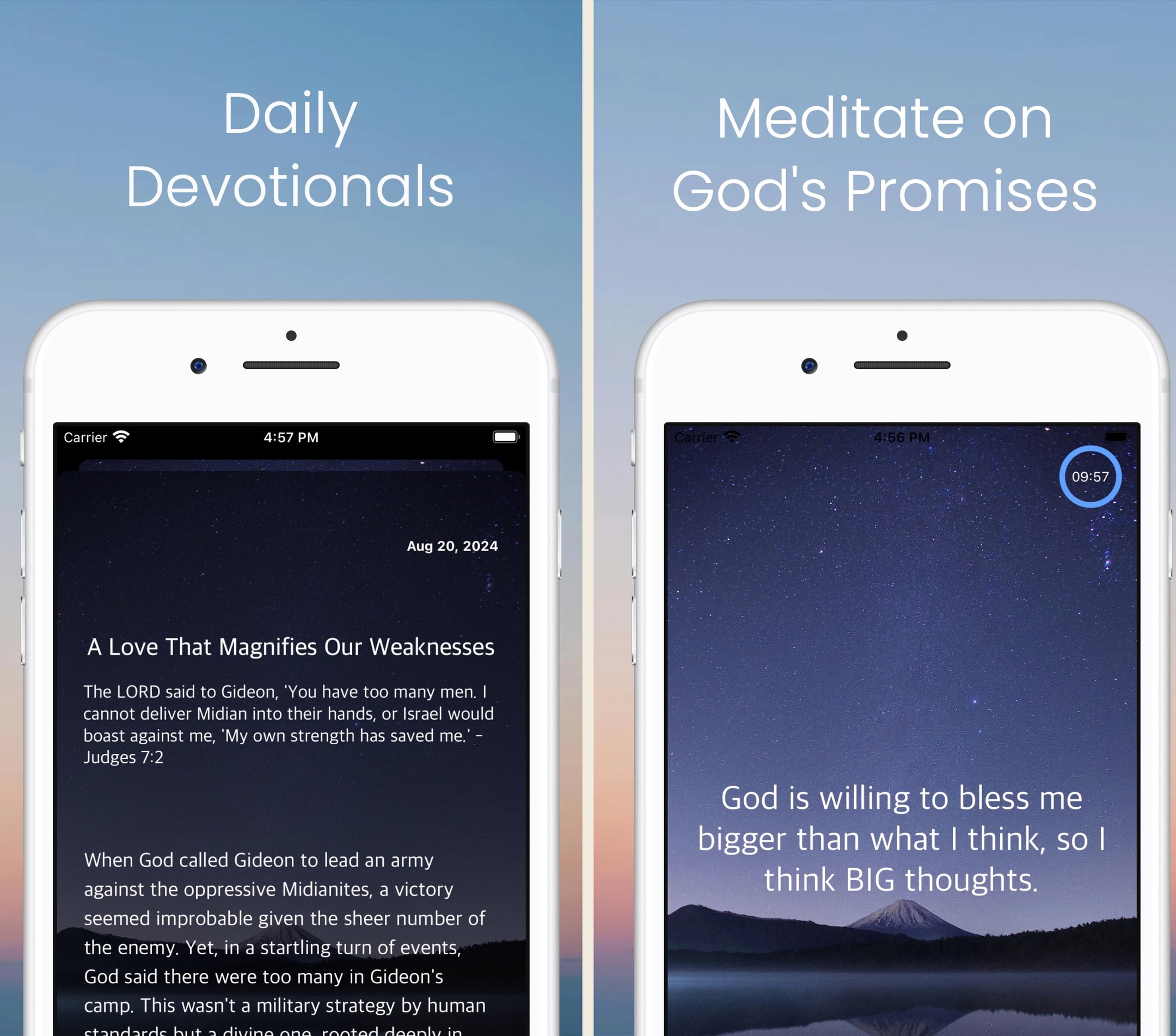
Setup and first run
Installing SpeakLife is the most singular first run we tested in the Christian-app category. We installed it on a fresh iPhone and were taken through a short onboarding — primary mental-health concern (anxiety, fear, sleep, identity, healing), preferred declaration length, the time of day for a daily prompt — and then dropped into the format that defines the app: a short audio prompt that asked us to speak a Scripture aloud rather than to listen to a recorded narration. For users coming from passive-listening meditation apps, the shift is immediate, and the design call is unambiguous — SpeakLife isn't trying to be Calm with crosses. It's trying to be a tool for one specific spiritual practice.
The first session in our testing was a five-minute anxiety declaration flow — three short verses (Philippians 4:6–7, 2 Timothy 1:7, Psalm 27:1), each held on screen for thirty seconds while the audio prompted us to speak the verse aloud, with brief pauses between. The audio was calm and stripped-down — no dramatic voice talent, no cinematic score, no manipulative emotional cues. After completing the session, we noticed something we didn't expect: speaking the verse aloud during a mild anxiety moment regulated our breathing in a way that hearing the same verse narrated wouldn't have. The format earned the product its slot for us in that first session.
Day-to-day use
We used SpeakLife primarily for three jobs over multiple weeks: a morning anxiety declaration as a regulating start to the day, a sleep-peace flow at bedtime during a stretch of insomnia, and longer themed multi-day flows during specific hard weeks (fear, identity).
Anxiety and fear declarations
The anxiety library is the headline use case and the design choice that makes SpeakLife work as a mental-health product. Sessions are short — five to ten minutes — and the format is consistent: a verse appears on screen, the audio prompts the user to speak it, a brief pause holds for the practice to land, and the next verse follows. The categorization is specific (panic, social anxiety, generalized worry, fear of the future), and the verse selection fits the category rather than being scattershot. After two weeks of daily anxiety declarations, the practice had become a reliable morning regulation tool — and meaningfully more useful than passive meditation during actual anxiety moments, because the act of vocalizing slows breathing and engages the body in a way listening alone doesn't.
Sleep and peace declarations
Bedtime declarations are the second pillar. The audio is meaningfully calmer at night, the verse selection leans on rest-and-peace passages (Psalm 4:8, Proverbs 3:24, Matthew 11:28–30), and the pacing is slow enough that the listener can speak a verse and then drift into sleep before the next prompt. We used the sleep-peace flow during a stretch of intrusive-thought insomnia and it worked — the spoken format broke the loop in a way passive bedtime audio hadn't for us. Several App Store reviews talk about exactly this pattern, and the format is well-suited to it.
Multi-day themed flows
The longer themed flows (overcoming fear, sleep peace, identity in Christ, healing) thread declarations across multiple days with a small narrative arc. We worked through a seven-day identity flow during testing and the structure held — each day built on the previous day's declarations, and the cumulative effect was meaningful in a way single sessions can't be. For users who want a curated path rather than browsing a flat list, the multi-day flows are the right shape.
Where it surprised us
The participatory format was the loudest surprise. We went into testing assuming spoken-Scripture declarations would feel performative or self-conscious — saying verses out loud in your living room is a different experience from hearing them. In practice, the format was meaningfully more regulating than we expected, especially during actual anxiety moments. The act of vocalizing slows breathing involuntarily, engages physical regulation systems that pure listening doesn't, and forces a kind of present-moment focus that's hard to achieve passively. After two weeks, we'd internalized a few of the most-used verses and were declaring them ad hoc during stressful moments — without the app — which is the highest compliment we can pay to a faith app.
The audio production calibration was the second surprise. Christian wellness apps often over-produce — dramatic voice talent, swelling music, manipulative emotional cues — and the over-production can fight a listener who's already anxious or dysregulated. SpeakLife's stripped-down audio was the right calibration for the use case. The pacing didn't push, the voice was calm rather than performative, and the design didn't try to make the practice feel cinematic. For panic-attack-grade anxiety and bedtime use specifically, the calibration matters more than the production budget would suggest.
The frequency of updates was the third surprise. The app shipped a new version within hours of our hands-on testing, which is unusual sustained velocity for a small indie Christian app. The product feels actively maintained, and the release cadence signals a developer who's iterating rather than coasting. For an iOS-only indie product, that velocity is a credibility signal worth flagging.
Where it disappointed
iOS-only is the loudest limitation. There's no Play Store version, and that's a real restriction rather than a coming-soon promise — DiosEstaAqui LLC hasn't published an Android timeline.¹ For the substantial portion of the mental-health-affirmation audience that's on Android, SpeakLife isn't an option, and we'd recommend Soulspace as the closest cross-platform alternative for users who wanted the mental-health-focused format.
The pricing stack is the most fragmented we've seen in the Christian-app category. Nine separate IAP tiers including three different yearly Patron variants ($19.99, $29.99, $49.99) is hard to explain charitably — the variants suggest aggressive paywall A/B testing that quotes meaningfully different prices to different accounts.¹⁵ The $9.99/year tier is the headline value if it appears for you; the $49.99 yearly tier is pricier than the format probably warrants. None of the prices are unfair for the depth on offer, but the variability is the main pre-purchase friction point.
The charismatic / Word of Faith framing won't fit every Christian tradition. 'Declarations' as a spiritual practice maps to a specific tradition — positive-confession theology, the broader Word of Faith movement, charismatic Pentecostal practice — and the framing isn't theologically neutral. For readers in those traditions, the practice is native; for cessationist Reformed users, the framing maps to a position they don't hold, and the experience can feel off even if the underlying Scripture is sound. The fit-check matters more than most pre-purchase questions, and for users it doesn't fit, Soulspace's broader-Protestant framing or Lectio 365's Anglican rhythm are closer alternatives.
It isn't a Bible reader and that's a structural limitation. Affirmations are quoted Scripture but the app isn't a place to look up or study a passage in context. For users who want a single app that covers both daily Bible reading and declaration practice, SpeakLife isn't, and the workflow becomes two apps (SpeakLife plus YouVersion or Olive Tree).
The user base is smaller than Abide or Soultime — roughly 1,100+ App Store ratings is credible but means the niche-fit is narrower.¹ The reviews we read were unusually specific and consistent — users credit the format with breaking specific insomnia and panic patterns — which is a stronger signal than a larger-but-vaguer review set, but the smaller user base does mean less variety of use-case validation than Abide's tens of thousands of ratings.
The pricing reality
The free tier offers daily affirmations, which is a reasonable evaluation surface — enough to feel out whether the spoken-Scripture format works for you before paying anything. Paid tiers are where the variability hits: nine SKUs total, with the headline value at $9.99/year (when that SKU appears for your account).¹ The $19.99 and $29.99 yearly Patron tiers are reasonable. The $49.99 yearly Patron tier is pricier than the format probably warrants for most users — at that price, Hallow Plus ($69.99/year)³ or Glorify Plus ($69.99/year)⁴ cover broader content libraries.
The Lifetime at $149.99 has surprisingly variable economics depending on which yearly SKU you'd otherwise be paying. At $9.99/year, Lifetime breakeven is roughly fifteen years, which doesn't actually pencil. At $29.99/year, breakeven is roughly five years, which does for committed users. At $49.99/year, breakeven is roughly three years, which is a real consideration for users certain they'll stay.
For most users, the advice is to install, evaluate the free tier for a week, decide whether the spoken-declaration format works for you, and then check the receipt screen carefully before tapping subscribe. If the $9.99/year SKU appears, take it — that's genuinely one of the cheapest credible Christian wellness subscriptions in the category. If a higher SKU appears, the $19.99 or $29.99 Patron tiers are still reasonable.
All paid plans visible on the SpeakLife: Bible Declarations App Store listing. Free trials and intro pricing may vary by region.
Weekly
- SpeakLife — Weekly$3.99
Monthly
- SpeakLife Patron — Monthly$4.99
- SpeakLife Premium — Monthly$6.99
- SpeakLife Patron — Monthly$9.99
Yearly
- SpeakLife — Yearly$9.99
- SpeakLife Patron — Yearly$19.99
- SpeakLife Patron — Yearly$29.99
- SpeakLife Patron — Yearly$49.99
One-time
- SpeakLife Premium — Lifetime$149.99
Who else should consider it
Charismatic, Pentecostal, and Word of Faith-adjacent readers will find SpeakLife's theological frame native and the practice already part of their spiritual life. The fit is the strongest in this audience.
Adults dealing with panic attacks specifically benefit from the participatory format more than from passive meditation — the act of speaking a verse during a panic moment regulates breathing in a way that hearing one doesn't. App Store reviews consistently flag this exact pattern, and our testing matched.
Listeners with intrusive-thought insomnia benefit from the bedtime sleep-peace flows. The spoken format helps interrupt repetitive thinking some users describe, in a way passive bedtime audio doesn't always do, and the design is well-tuned for sleep-onset use.
Couples who pray together can use SpeakLife declarations as a shared practice — speaking Scripture together over a hard moment is a different shape from listening together, and the participatory format works for couples in a way passive content sometimes doesn't.
Our final word
SpeakLife in 2026 is the only credible Christian app built around speaking Scripture aloud as a mental-health practice, and inside that specific lane — anxiety, fear, sleeplessness, on iOS — it's the right pick. The format is therapeutically distinct from passive listening, the App Store reviews consistently credit it with breaking insomnia and panic patterns, and the $9.99/year entry point (when it appears) is genuinely reasonable. The misses are honest and significant: iOS-only, fragmented pricing, a charismatic / Word of Faith frame that won't fit every tradition, and a structural limitation as a non-Bible-reader product. For the audience the app actually serves — iOS users in charismatic-adjacent traditions who want spoken Scripture as a mental-health practice — SpeakLife is the only credible product, and the install is easy at the right price tier. Pair it with a primary Bible reader (YouVersion, Olive Tree, Bible Gateway). Outside its specific lane, the alternatives fit better, and we'd send those users to Soulspace, Soultime, or Abide first.
Best for
iOS users who specifically want to declare Scripture over anxiety, fear, or sleeplessness as a spoken practice rather than passive listening.
Skip if
Android users (no Play Store version), cessationist Reformed readers, or anyone who wants a Bible reader — SpeakLife is an audio-affirmation product, not a Bible app.
What real users say
A new found friend!
I really don’t know how I came across SpeakLife I believe I was on the App Store looking for something else when the SpeakLife app appeared, so I looked into it. I love Bible apps that give you access to more Bible knowledge and affirmations so as I was discovering all of wonderful things that were included in SpeakLife I decided that this was something I needed in my life and I am so glad that I did. Because it was so well put together and informative. I have shared it with many people. I thank God for you all.
— Purestarcep17 · January 4, 2025
Worth the Download!
I just found this App & everything I’ve read has been rooted in Scripture (My requirement in my recent Lifelong commitment to Jesus Christ! I highly recommend getting this App to ensure (like myself) you are firmly rooted in the Truth & the Light of Christ in a World of Darkness, Selfishness, & Deceit! May we all find Peace, Grace, & Love by becoming everything our Heavenly Father designed us to be in this Life! Props & Kudos to the Developers for an incredible tool to be a Giver in a world full of Takers. Godspeed
— HippyChick867🌸 · December 31, 2024
Wonderful!
I love how the app represents the WORD OF GOD and I appreciate the affirmations and peaceful quotes. I do believe that more background images could be uploaded or you could give the option to upload our own background images. Another update could be saving the photo of affirmation to our galleries from the app. Whenever the image saves, the name of the app will be saved on it so when it is posted whether on social media or wherever, the name of the app will be on it. This could be used to market the app even more. Thumbs up😂
— Na$$$$$$$sssss · April 9, 2023
Love this glorious App
I’m so thankful and grateful for the blessing of this wonderful App❣️ I’m not very knowledgeable (ha so you can see by that declaration how desperately I need to SpeakLife🤪) and this App magnificently does exactly that, it beautifully speaks life to my very soul with God’s Holy Word. Thank you from the bottom of my heart.💖 Jesus Christ loves us all and He’s coming back. Don’t take the mark of the beast, don’t leave this world without Him, may God bless us, have mercy on us and take care.🙏🏻👼
— mama and grandma for Jesus · February 17, 2025
Nothing in the World is better!
I had randomly gotten Bells Palsy and half my face was stuck! I went to the emergency room and a dr told me my face might not ever recover! I found this app and favorited 3-5 healing promises and said them 3-10 times a day and as the days went on I woke up and face started recovering a little each day! Now to say my face is fully healed all praise to the Most High! Forever grateful for Gods promises!
— Abbasfavorite · December 5, 2023
Alternatives we considered
Compare SpeakLife: Bible Declarations to other Bible apps
Warmpeach — coming soon
A Bible chat app — pastor and therapist in one.
Warmpeach is a Bible chat app that blends a pastor's care with a therapist's questions, grounding every reply in scripture. Join the waitlist and we'll email you when it opens up.
Sources
-
SpeakLife: Bible Declarations — App Store listing (in-app purchases, nine IAP tiers, $9.99–$49.99 yearly Patron variants, $149.99 Lifetime, App Store rating count, iOS-only). Accessed 2026-05-08. https://apps.apple.com/us/app/speaklife-bible-meditation/id1617492998
-
SpeakLife — official site. Accessed 2026-05-08. https://speaklifebibleaffirmations.com/
-
Hallow — App Store listing (Plus annual pricing). Accessed 2026-05-08. https://apps.apple.com/us/app/hallow-prayer-meditation/id1405323394
-
Glorify — App Store listing (Plus annual pricing). Accessed 2026-05-08. https://apps.apple.com/us/app/glorify-devotional-prayer/id1490587079
-
Hands-on testing notes captured during 2026-05 — paywall variants observed across multiple yearly Patron SKUs, free-tier behavior, App Store reviews sampled for sleep-onset and high-anxiety use-case patterns. Raw screenshots in our internal archive.