
Soultime Review
By Sankalp Jonna · Last reviewed 2026-05
Get the app
How we tested
Every app here was installed and used personally. We capture raw findings — typed notes, screenshots, screen recordings, voice memos — and the writing is AI-assisted from those raw notes. Scores, rankings, and "best for / skip if" calls reflect our actual experience with each app. Read the full methodology →
Our verdict
We'd recommend Soultime to adults whose headline reason for a Christian app is mental health and who want depth — a real mood tracker, a library indexed by emotion, an audio Bible inside the same app, and a thoughtfully-designed safety net (Soultime with Friends). For Anglican, mainline Protestant, and broadly ecumenical readers, the theological frame fits cleanly, and the Justin Welby endorsement is a credibility signal that matters in a category where most apps ship with a megachurch partnership and call it vetted. As a paid Christian-meditation product with mental-health depth, this is the closest thing to a clinically-minded design we've used. Skip Soultime if you're cessationist Reformed and want explicitly Reformed teaching — the Anglican frame won't fit. Skip it also if you want a serious Bible reader (the audio Bible is functional but obviously AI-narrated, and there's no chapter view that competes with Olive Tree or YouVersion), or if Android polish matters to you and a 4.1 Play Store rating is a real concern. Soulspace is the cheaper, free-tier-first alternative; Abide is the deeper bedtime-story library; Hallow is the Catholic pick. For users who specifically want the mood-tracker-plus-meditation combo, Soultime is the deepest available.
Setup and first run
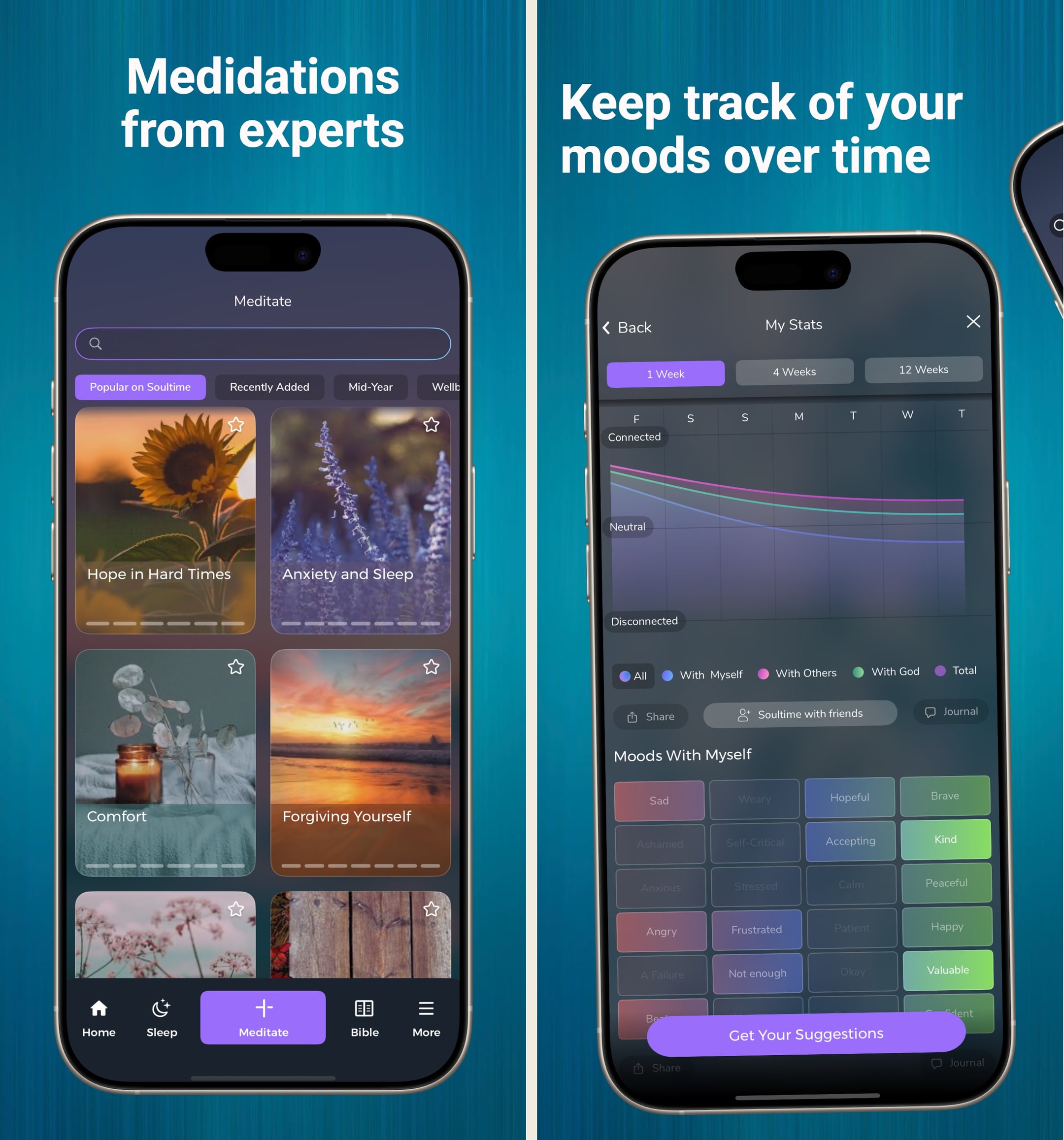
Installing Soultime is the most check-in-first onboarding we tested in the Christian-meditation category. We installed it on a fresh iPhone and were taken through a short setup — primary mental-health goals (anxiety, sleep, depression, stress, hope), preferred meditation length, the time of day for a daily reminder — and then routed not to a content library but to a mood check-in. The home screen asked how we were feeling, and only after we'd logged a mood did the app surface a recommendation. For a product whose headline differentiator is mood-aware content, putting the mood tracker on the front rather than burying it three taps deep was the right design call.
The first session in our testing was a guided meditation paced for moderate anxiety — fifteen minutes, slow narration, deliberate pauses, a Scripture passage held in front of the listener for the third quarter of the session. The production wasn't trying to impress us — no dramatic voice talent, no cinematic score — but the pacing and Scripture selection were tuned for emotional regulation rather than for a generic devotional reflection. After the session ended, the app re-asked our mood and logged the delta. The before-and-after framing is rare in this category and turned out to be one of the reasons Soultime stuck for us — the practice felt measurable in a way most meditation apps don't.
Day-to-day use
We used Soultime primarily for three jobs over multiple weeks: a daily mood check-in with a routed meditation, themed sessions during specific hard stretches (anxiety, grief), and the audio Bible as supporting content alongside the meditation library.
Mood tracker plus AI recommendations
The mood-tracker-driven content surfacing is the design feature that earned Soultime its spine slot. Log how you're feeling on a multi-dimensional scale (low / high mood, calm / anxious, hopeful / hopeless), and the app routes you to a meditation indexed for that emotional state. After two weeks of testing, the routing felt meaningfully more useful than browsing a flat library when we were actually struggling to know what we needed. The AI recommendation is opaque — we couldn't tell exactly what was driving the choice between two anxiety meditations — but the surfaces matched our mood enough that we stopped second-guessing them.
The before-and-after mood logging was the second design choice that paid off. Logging mood at session start and again at session end gave us a small visible record of which sessions actually moved the needle and which didn't. Over a few weeks, the patterns clarified — particular narrators worked better for our specific anxiety patterns; the slower-paced sleep tracks worked better than the daytime ones at bedtime. That kind of self-discovery is the part most meditation apps don't enable, and Soultime does.
Themed meditations
The themed library covers anxiety, sleep, stress, depression, anger, hope, grief, and similar emotions. Sessions run ten to twenty minutes, and the framing is paced for actual emotional regulation rather than for generic devotional reflection. We worked through several depression sessions during a hard week and the pacing was sober and patient — the app didn't try to talk us out of how we were feeling, and the Scripture selection landed on lament psalms rather than on triumphalist promises. For users who've bounced off Christian content that papers over depression with 'rejoice always' framing, Soultime's clinical-minded handling is a real differentiator.
Audio Bible
The audio Bible inside Soultime is the supporting product. It's AI-narrated, and the voice is recognisably synthetic next to Dwell's human narrators or Bible.is's professional readings. For users for whom audio Bible quality is the headline reason they're installing an app, this isn't the right pick. For users who want the audio Bible as supporting content — listening to a passage that anchors a meditation, hearing a chapter in the morning before a daily session — the coverage is enough. We used it as supporting content rather than as a primary listen, and in that role it held.
Soultime with Friends
We tested 'Soultime with Friends' with a small group of nominated contacts during the testing period. The feature lets you alert trusted people when you need support — a low-friction way to reach a human on a hard day. We didn't have a real crisis during testing, but we used the feature for a check-in during a stressful week and the experience was clean: the contact got a notification, we exchanged a few messages, and the friction was low enough that we'd actually use it again. For a product that takes mental health seriously, the safety-net design is one of the most thoughtful choices in any Christian app we've used.
Where it surprised us
The clinical-mindedness of the depression library was the loudest surprise. Most Christian apps in this category treat depression as a content category alongside 'gratitude' and 'peace,' and the framing tends toward triumphalism — verses chosen to reassure rather than to sit with the reader in the darkness. Soultime's depression sessions were paced and framed differently. Sessions sat in lament; Scripture selection leaned on the lament psalms; narration was patient rather than corrective. For users who've bounced off Christian content that doesn't seem to take depression seriously, Soultime's handling is a real product differentiator.
The Justin Welby endorsement was the second surprise.² We went into testing assuming it was marketing furniture; the more we used the app, the more it felt earned. The theological frame is gentle, ecumenical, and clinical-leaning rather than charismatic or hard-Reformed, and it matches what a thoughtful Anglican mental-health product would look like. For ecumenical and mainline Protestant readers specifically, the frame is native and the credibility signal is real.
The before-and-after mood logging was the third surprise. We didn't expect a small detail to matter as much as it did, but seeing the delta after a session felt rewarding in a way that pure session-completion tracking doesn't. After a few weeks, the practice of logging-and-comparing was itself part of the regulation — the act of paying attention to how a meditation moved us was useful beyond the meditation itself.
Where it disappointed
The pricing fragmentation is the main credibility problem. Five different annual SKUs from $29.99 to $59.99 means the price quoted in onboarding can vary materially between users — the SKU shown to your account may not match the SKU shown to a friend.¹⁷ The Quarterly $19.99 SKU is ambiguously labelled (Apple's listing tags it as 'yearly' billing, which doesn't match the 'Quarterly' name in the app), and we wouldn't recommend it until that's clarified.¹ None of the prices are unfair for the depth on offer, but the variability is the main pre-purchase friction point.
Android polish lags iOS materially. The Play Store rating is 4.1 against the App Store's 4.7, and our hands-on testing matched the gap — the Android version felt a half-step behind in animation smoothness, audio loading reliability, and check-in flow polish.¹³ For Android users specifically, Soulspace or Abide may fit better; Soultime's design strengths translate but the execution is meaningfully tighter on iOS.
The audio Bible is functional but obviously synthetic. The AI narration is recognisable — voice consistency across translations is good, but the cadence has the small artifacts that AI-narrated audio still carries in 2026. For users for whom audio Bible quality is the headline use case, Dwell or Bible.is are the right picks; Soultime's audio Bible is supporting content, not a primary product.
The theological frame won't fit cessationist Reformed users. The Anglican / mainline Protestant tone is the credibility advantage with one audience and a fit-check with another. Reformed readers who want explicitly Reformed teaching should look at Lectio 365 (closer to ecumenical Anglican) or pair a Bible app with a Reformed devotional resource — Soultime isn't trying to be that.
The pricing reality
The free tier offers limited daily meditations — enough to evaluate quality but not enough to use heavily. Premium pricing depends on which SKU your account sees: Annual at $29.99, $39.99, $47.99, or $59.99 are all live SKUs, with the $29.99 tier as the headline value if it appears.¹ Monthly tiers at $5.99 and $7.99 compound to $72–96/year, materially worse value than even the most expensive annual SKU. The Quarterly $19.99 SKU has cadence ambiguity and we'd avoid it.
For most committed users the annual is the right pick, and the price comparison is favorable: $29.99–$59.99/year sits at or below Abide ($59.99/year)⁴, Hallow ($69.99/year)⁵, and Glorify ($69.99/year)⁶. The depth — mood tracker, 250+ themed meditations, audio Bible, Soultime with Friends — is reasonably valued at any of the annual prices. The advice is to install, evaluate the free tier for a week, and then check the receipt screen carefully before tapping subscribe.
All paid plans visible on the Soultime Christian Meditation App Store listing. Free trials and intro pricing may vary by region.
Monthly
- Premium — Monthly$5.99
- Premium — Monthly$7.99
Yearly
- Premium — Quarterly$19.99
- Premium — Annual$29.99
- Premium — Annual$39.99
- Premium — Annual$47.99
- Premium — Annual$59.99
Who else should consider it
Anglican, Episcopal, and mainline Protestant readers will find Soultime's theological frame native — gentle, ecumenical, and clinically-leaning rather than charismatic or hard-Reformed. The Justin Welby endorsement is a credibility signal that fits this audience specifically.
Couples and small groups can use Soultime with Friends to maintain a low-friction check-in network during hard seasons. The feature is the closest thing the Christian app world has to a real safety net design, and for couples or close friends who want to know how each other is actually doing, it's the right tool.
Adults dealing with depression specifically benefit from the lament-leaning content and the patient pacing. We've used many Christian apps that treat depression as 'low mood' and try to talk the listener out of it; Soultime sits with the user instead, and that calibration matters for actual depression rather than for marketing-language depression.
Our final word
Soultime in 2026 is the deepest mood-tracker-plus-meditation library in Christian wellness, and for adults whose headline reason for installing a Christian app is mental health, this is one of two top picks (alongside Soulspace at the free-tier-first end and Abide at the deeper-library end). The mood tracker plus AI recommendations plus the lament-leaning depression library plus 'Soultime with Friends' add up to a product that takes mental health seriously rather than just labelling content with anxiety tags. The misses are honest: the pricing stack on the App Store is messier than it should be, Android polish lags iOS, the audio Bible is obviously AI-narrated, and the Anglican / mainline Protestant frame won't fit cessationist Reformed users. Inside its lane — clinically-minded Christian wellness for ecumenical and mainline readers — Soultime is the deepest available, and the annual Premium tier (at whatever price your account sees) is reasonable for the depth on offer.
Best for
Adults who want Christian meditation organised around mental-health themes — anxiety, sleep, depression — with a mood tracker and Scripture inside one app.
Skip if
Cessationist Reformed users, readers who want a serious Bible reader rather than a meditation-first product, or users who can't tolerate fragmented App Store pricing.
What real users say
BEST APP IN EXISTENCE
I love this app so much, I actually paid for a whole year! First time & only time I will ever spend hard working money on an app! This app has become such an uplifting essential part of my life! I literally cannot go to sleep without it. I have listened to ever single session on here in every category at the least five times a piece. This app is seriously life changing, my eight year old niece finds so much interest in it & looks forward to hearing it with me while we fall asleep when she sleeps over! The only downfall for me, because I listen to every single night, is lack of new catergories & sessions. I would love for a bereavement category to be added to help cope with the loss of loved ones, addiction struggles, pregnancy, etc. I do realize that the team is still small in size, but I really am looking forward to hearing more. Also I wish there were an option to be able to play so many sessions at a time, of maybe play all the sessions at once in each category, I like to listen to all of the sessions in one category at a time. I dislike I have to get up & to hit the next mediation button. I cannot thank you enough for taking the time to build this heaven sent app Take care & GOD BLESS YOU ALL MINDY SCHEFFLER 💒❤️🙌🏼
— Mindy Scheffler · May 6, 2019
Make peace with the monsters in your closet.
As a deep feeler, I tend to hide in social media, sleep, entertainment, food, or just about anything else that might give me an escape from my emotions. It felt like if I allowed space to examine what exactly was in my emotional closet, the monsters would come charging out and overwhelm me, and depression, despair, anxiety, self-hate, bitterness, and other self-destructive states would take over. So, when I started this app, I was a bit apprehensive about what I would encounter in the quiet of my soul. However, what I found was forgiveness, both for others and myself. I found insight into my present by looking at my past. I broke agreements with lies that had been written on my heart since childhood. And, bit by bit, I’ve tasted peace there in the quiet of my soul. Yes, I did have to do a bit of battling of my demons. But in that space, they became small, sickly things, because I saw them in the context of the love and power of God. He led me with gentleness in each session, and held me when I wept. Through these short little meditations, I’ve experienced the love of God in deep, powerful ways. If you’re looking for a little more Jesus and His peace, this is the app for you.
— Emilysledge11 · March 10, 2019
I use the app daily
I use the meditation and Daily Bible daily as part of my morning routine. Now that I have written the review, it still asks me to write a review after doing the daily meditation and rating the meditation within the app. The way to get around that is to either rate the meditation below 5 stars or exit it without rating it. It seems though that the rating is connected to the counter. Sometimes the counter increments and sometimes it doesn’t. Update: The developer responded and unfortunately it is an aspect of the app. This is actually a relatively new thing that was added because I have used this app since fall 2020 and the review request was not a feature then and for quite some time. I don’t remember when it popped up. I have numerous issues with this app and have to restart it, e.g., the daily Bible crashes or doesn’t open. However, I still subscribe to the app via it’s annual fee to support the developers. In particular, I like the Biblically based daily guided meditations which is a unique feature of this app that I haven’t found elsewhere.
— Gffvh · April 13, 2023
Be still my soul
I’ve been using this app for over two years now, and I can’t fully put into words what this app means to me. Soultime has changed my morning prayer time from a session of sleepy chanting and unstructured rambling to a quiet, meditative contemplation of the heart with meaningful prayers. No one ever taught me how to pray, so it’s always been a little uncomfortable. And while meditation apps seem helpful when I get stressed out, often times they only focus on breathing or they center around buddhist or secular views. Instead, Soultime has been there for me in the midst of my panic, helping me to breathe and reminding me of God’s promises. When I wake in the morning, the daily meditation often hits a soft spot - like a song on the radio that makes you melt because you needed to hear it. I’ve grown in my walk with God through the guidance of this app, and I cherish the narrators and developers behind it. If you’ve always wanted to nourish your prayer life, or set aside time every day for heavenly thinking, but you don’t know where to start - starting with Soultime is a wonderful idea.
— SpinyStarfish⭐️ · November 22, 2022
Great app but needs some work
First off this app is well worth the cost. It has helped me so much with stress and getting a good nights rest. This is my second time reviewing after using the app for awhile. It says family sharing but what I understand from family sharing is that your family can use app but have their own account. This doesn’t allow that. You all have to be on the same account which doesn’t make much sense since there is journal writing and it keeps up with which meditations you’ve completed and have not completed. I am private and would like my journal to stay private and not share it. The other thing is the background pauses every minute or so and can be very distracting so I’ve opted to not use it. I did send an email and was told I’d have to delete app and reload to see if it fixes the problem. I was also told if I delete it I will lose everything I’ve put into it. There are apps that you are able to have an account and it will save it for you regardless if you delete it and re add it to your iPhone. Love the app and it’s been a blessing but I would definitely recommend fixing these issues.
— Ireland222015 · May 21, 2019
Alternatives we considered
Compare Soultime Christian Meditation to other Bible apps
Warmpeach — coming soon
A Bible chat app — pastor and therapist in one.
Warmpeach is a Bible chat app that blends a pastor's care with a therapist's questions, grounding every reply in scripture. Join the waitlist and we'll email you when it opens up.
Sources
-
Soultime Christian Meditation — App Store listing (in-app purchases, annual and monthly SKUs, free-tier behavior). Accessed 2026-05-08. https://apps.apple.com/us/app/soultime-christian-meditation/id1369059690
-
Soultime — official site (Justin Welby endorsement, mood-tracker product page, Soultime with Friends feature). Accessed 2026-05-08. https://soultime.com/
-
Soultime — Google Play listing (Android rating, version polish). Accessed 2026-05-08. https://play.google.com/store/apps/details?id=com.soultime.app
-
Abide — App Store listing (annual pricing). Accessed 2026-05-08. https://apps.apple.com/us/app/abide-bible-prayer-meditation/id726031617
-
Hallow — App Store listing (Plus annual pricing). Accessed 2026-05-08. https://apps.apple.com/us/app/hallow-prayer-meditation/id1405323394
-
Glorify — App Store listing (Plus annual pricing). Accessed 2026-05-08. https://apps.apple.com/us/app/glorify-devotional-prayer/id1490587079
-
Hands-on testing notes captured during 2026-05 — paywall variants observed across multiple yearly SKUs, mood-tracker behavior, Soultime with Friends test runs. Raw screenshots in our internal archive.