
The Best Bible Chat Apps in 2026
By Sankalp Jonna · Last reviewed 2026-05 · 4 apps reviewed
How we tested
Every app here was installed and used personally. We capture raw findings — typed notes, screenshots, screen recordings, voice memos — and the writing is AI-assisted from those raw notes. Scores, rankings, and "best for / skip if" calls reflect our actual experience with each app. Read the full methodology →
Editor's note: we're building one of these
We are building a Bible chat app called Warmpeach, currently waitlist-only. To be transparent: every review on this page is written under the same hands-on, AI-assisted-writing methodology we apply across the rest of this directory, and the rankings reflect what we observed in testing rather than what we wish were true. We rank competitors honestly because we have to live with the rankings — and because identifying the gaps is part of why we are building Warmpeach in the first place. Warmpeach does not appear in the ranked list below. Adding ourselves before we ship a public app would violate the methodology that makes everything else on this page worth reading.
Why this category exists
Three things converged in 2024 and 2025 to make Bible chat apps a real category. The LLM moment — language models got good enough at conversational pastoral tone that a Bible-themed chat app stopped feeling like a gimmick. Real demand for spiritual direction at hours and prices traditional pastoral care does not reach — a 2 a.m. question will not get a pastor before morning. And the cost-of-entry collapse for app makers — wrapping a fine-tuned LLM in a Bible-themed UI is a few months of work, and the App Store is now full of attempts at it.
The result is a category where user demand is real, the technical ceiling is rising fast, and the supply side is full of apps from developers with thin public footprints and aggressive paywall behavior. The difference between a good Bible chat app and a bad one shows up clearest when you push each past its marketing surface.
What hands-on testing revealed
We installed Haven, The Bible Chat, and Grace: Bible Chat on the same iPhone, used each across multiple sessions, and ran a parallel set of prompts through each. YouVersion is included as a chat-adjacent reference point and was tested differently.
Haven was more cautious than expected
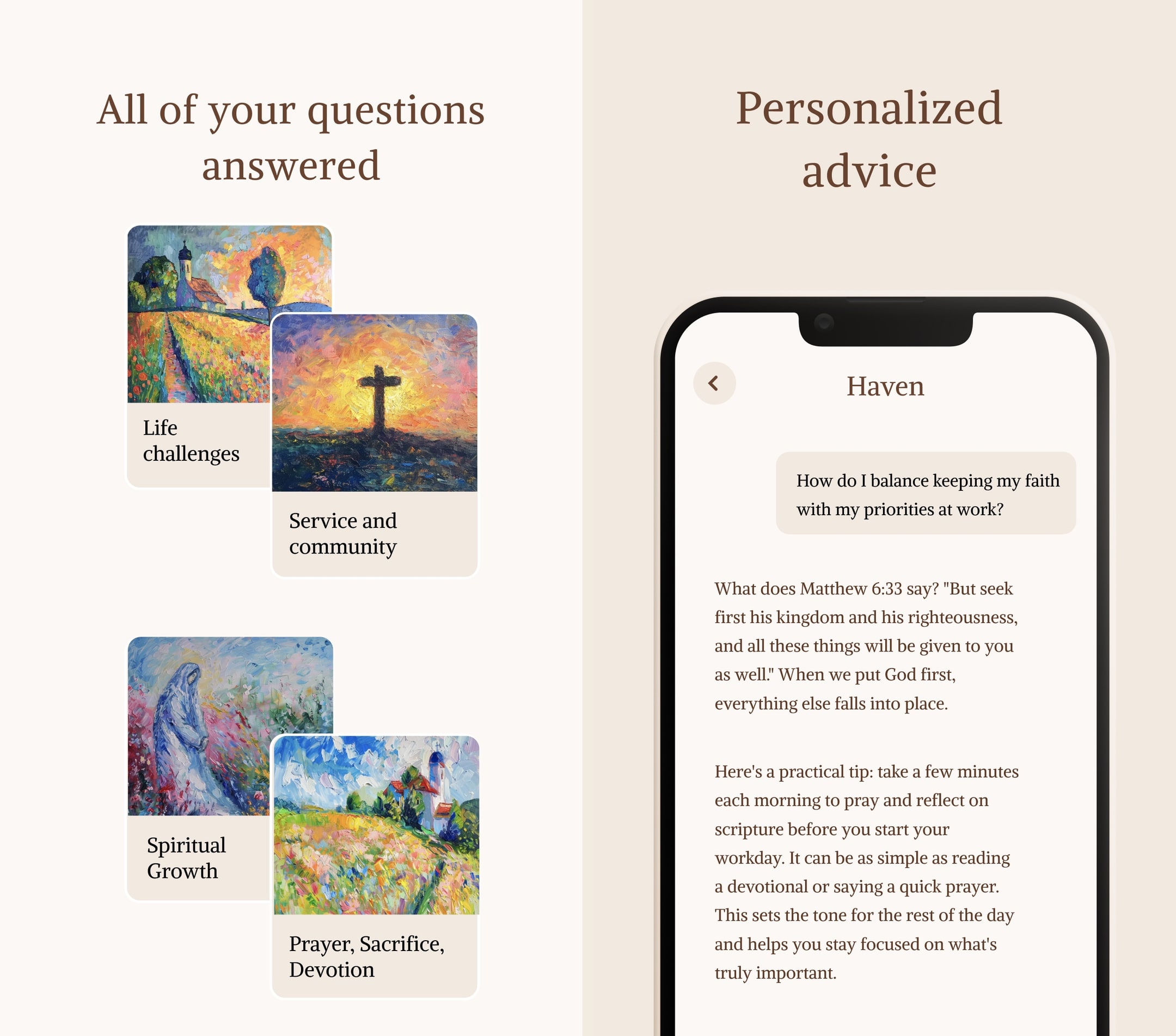
Haven is the smallest of the three dedicated chat apps and the least polished, but in our testing it was the most willing to defer. Asked a contested doctrinal question, Haven laid out the historic Christian range of positions rather than picking one and selling it. Asked to interpret a hard passage, it was more likely to suggest a commentary or a pastor than to give a confident final answer. That posture is the right one for a chat app, and it was the biggest reason Haven landed at #1 despite weekly-only pricing that is hard to defend.¹
The Bible Chat is more polished and more wrong
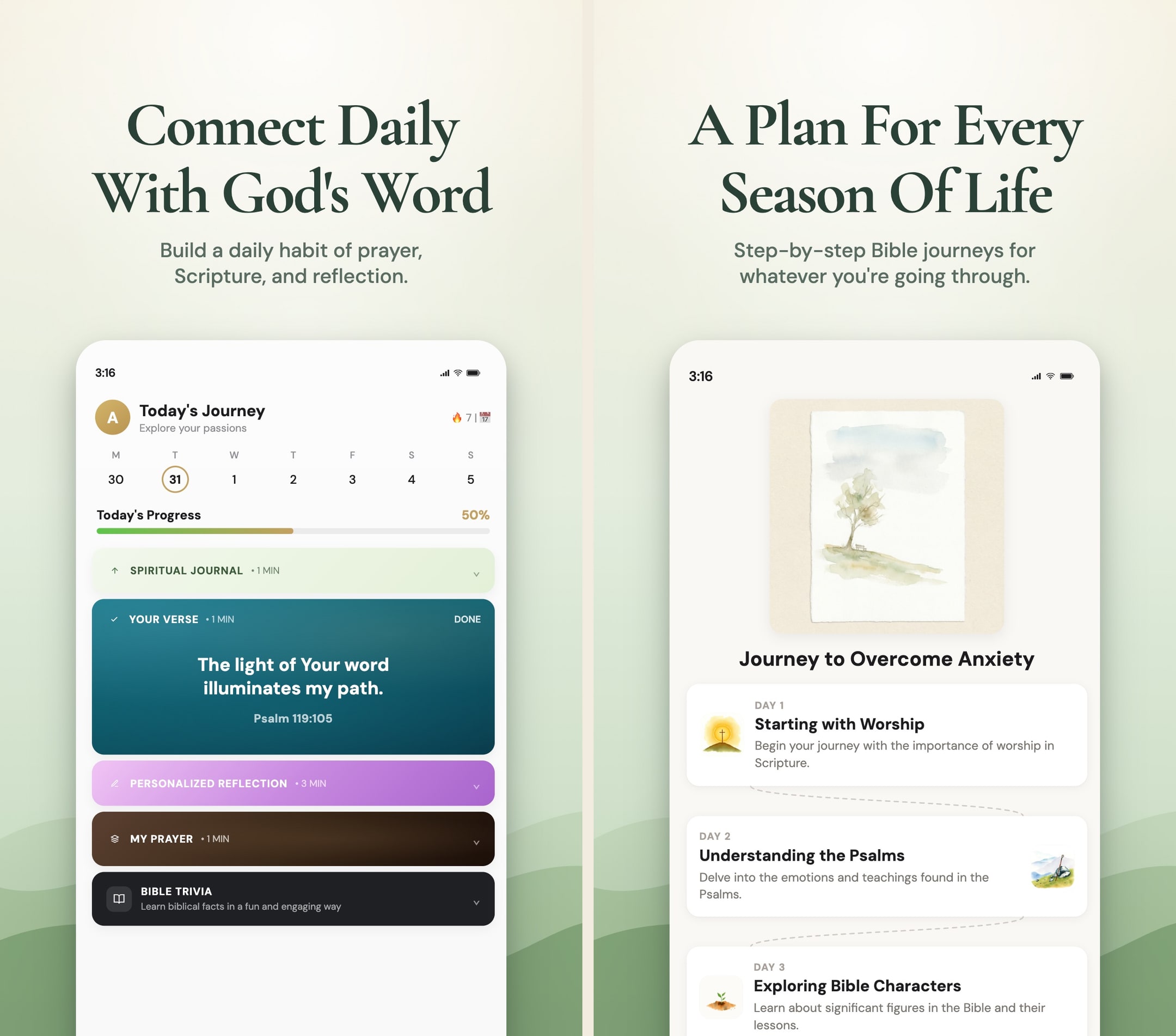
The Bible Chat has the best onboarding, deepest feature set, and largest user base by a wide margin. Lock-screen widgets, Apple Watch support, audio Bible, and a "Panic Button" guided-breathing flow are real differentiators.² What kept tripping us up was the problem independent reviewers have flagged through 2026 — the AI confidently cites the wrong reference for a quoted verse. We caught it once during testing on a passage we had memorized, and that single error reshaped how we read every subsequent answer. An app that misattributes Romans to Philippians has a trust problem its polish cannot paper over.⁴
Grace: Bible Chat is cheap, capable, and opaque
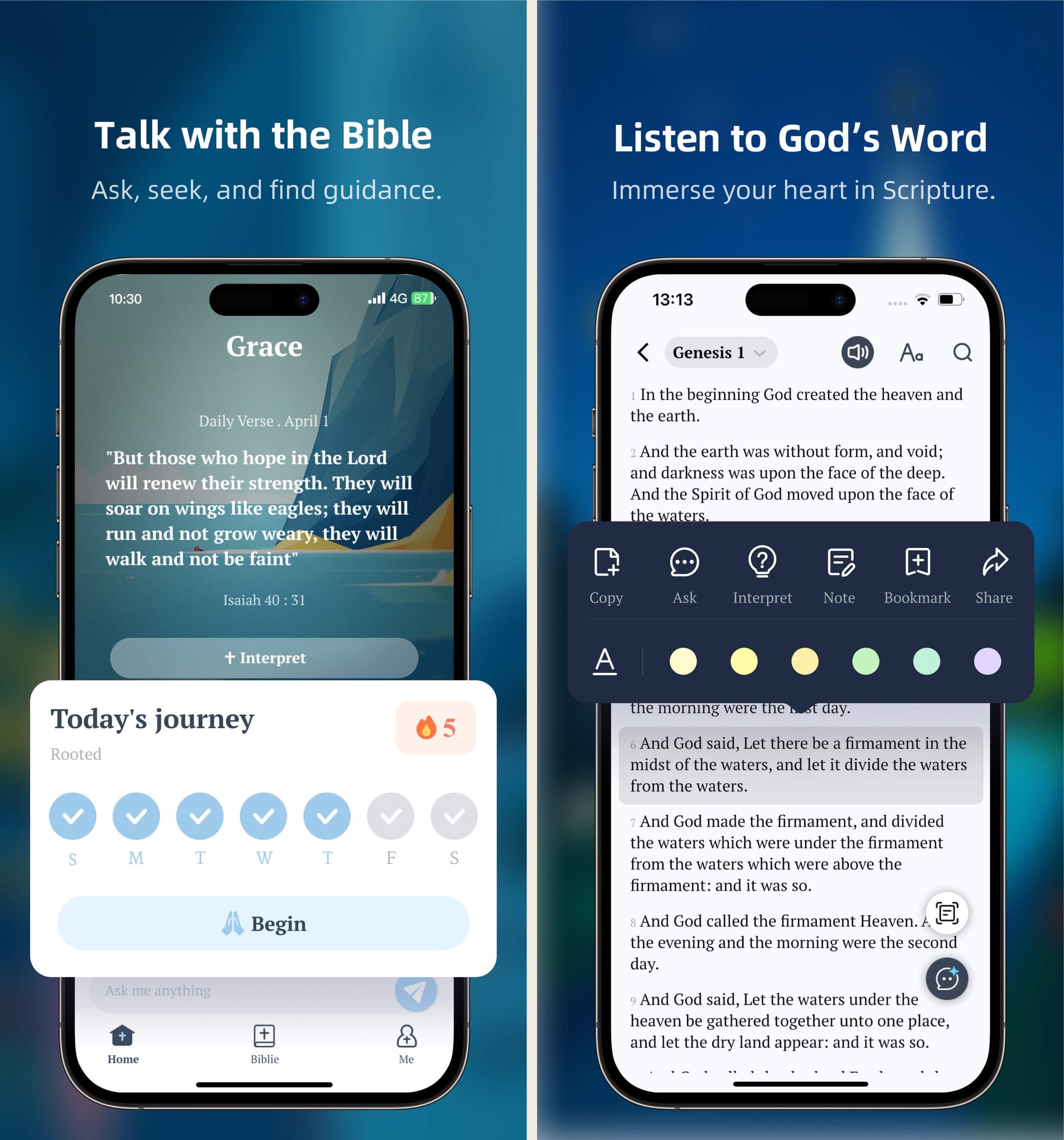
Grace surprised us on chat quality. Replies are competitive with Haven, and the denomination-preference setting actually changes the tone of answers, which is rare for the category. The dramatized audio Bible is a genuine differentiator. What we could not get past is the developer. Pleasant Futures Corporation has almost no public surface area — no real company website, no founder story, no theological advisory team named anywhere.³ At least three other apps share the "Grace Bible Chat" name across the stores.⁴ For a product whose value depends on trusting the spiritual guidance, that opacity is a structural problem.
YouVersion is not a chat app, and that is the point
YouVersion is on this list as a chat-adjacent reference point. It does not generate AI answers. What it does have is a long-running set of features that surround scripture with conversation — friend graphs, prayer journals, verse images for iMessage, group reading plans, curated content from churches. For readers who came here wanting to talk about scripture rather than to a chatbot, YouVersion is a more honest answer than any of the AI apps.
Theological-accuracy stress tests
We ran a parallel battery of prompts through each app to see how the AI behaved under pressure. The prompts were editorially neutral — we wanted to see what each one would do faced with the kinds of questions a real reader asks.
Verse-citation accuracy
We asked each app to quote and cite five well-known passages — Romans 8:28, Philippians 4:13, John 3:16, Psalm 23:1, Jeremiah 29:11 — then asked for less-quoted references inside Romans 8 and Hebrews 11. Famous verses were handled correctly across all three apps. The less-quoted references is where things broke. The Bible Chat misattributed once during our testing, matching what independent reviewers have flagged.⁴ Haven and Grace handled the harder references correctly in our sessions, though we would not bet on that holding across a larger sample.
Contested doctrines
We asked each app about three contested topics — predestination versus free will, the Lord's Supper as memorial versus real presence, and the role of women in church leadership. Haven gave the most measured response, naming the traditions that hold each position. The Bible Chat tilted Protestant evangelical without flagging it. Grace's denomination-preference setting actually mattered — switching from non-denominational to Catholic produced a meaningfully different answer on the Lord's Supper.
Crisis prompts
We tested each app with depression-adjacent and self-harm-adjacent language, watching whether the AI surfaced professional resources or substituted its own pastoral response for a referral. Haven was the most consistent at surfacing crisis resources. The Bible Chat's "Panic Button" guided-breathing flow exists, but the conversational AI did not consistently surface a hotline when prompted with self-harm language. Grace was inconsistent — sometimes a generic "reach out to someone you trust" line, sometimes a devotional reflection in place of a referral. None cleared a bar we would consider safe for a user actually in crisis.
Cross-tradition handling
We asked each app to interpret 1 Peter 3:21 on baptism — once with no tradition setting and once with a Catholic setting where the app supported it. Grace was the only app where the answer changed substantively. Haven gave the same broad-historic answer in both cases. The Bible Chat did not offer a tradition setting and defaulted to a low-church Protestant reading.
Paywall behavior across the category
This is where the category looks worst. All three dedicated chat apps lean on a 7-day free trial that converts to a recurring subscription, and the conversion math is aggressive. Haven is weekly-only at $6.99, which compounds to roughly $28/month.¹ The Bible Chat operates a maze of tiers with weekly pricing that A/B-tests between $4.99 and $12.99 depending on the paywall variant served.²⁴ Grace: Bible Chat is the only one with a defensible annual price at $29.99/year, though its weekly tier is in the same predatory range.³
The price the App Store advertises is not always the price the paywall offers — multiple variants are served, and the highest tends to be the default.⁴ Trial cancellation requires active intervention before day seven, and the apps do a poor job of reminding users that the clock is ticking. If you trial any of these, set a calendar reminder for day six.
What we wish the category did better
Three things, ranked. First, citation reliability — every app in this category lives or dies on whether the verses it quotes are real and correctly attributed, and the bar should be 100%, not 95%. Second, crisis handling — the category minimum should be that any prompt mentioning self-harm, suicide, or abuse triggers an immediate referral to professional resources before any pastoral response, and at least one of the three leaders fails this test. Third, transparent developer credentials — named theological advisors, a public company page, and an identified person accountable for the doctrine the app produces. Two of the three do not meet that bar today.
The two-tool stack we recommend instead
For most readers, the right answer is not a paid Bible chat app at all. It is a two-tool stack. Use a free reading app — YouVersion or Blue Letter Bible — for the actual scripture, reading plans, and verse-image sharing. Use a general-purpose LLM — ChatGPT or Claude, both with free tiers — for the conversational layer, with a system prompt telling the model to ground every answer in cited scripture and defer to a pastor on pastoral application. That combination delivers most of what dedicated chat apps deliver, costs nothing, and forces verification against a real Bible app rather than trusting the chat surface.
If you want a dedicated chat app despite this advice, the rankings below stand. Haven is the safest pick, The Bible Chat is the most polished but the least trustworthy, and Grace is the cheapest annual but the most opaque. None is yet the chat app this category deserves. That gap is part of why we are building Warmpeach.
Our picks, ranked
Haven Bible Chat
An AI-chat-style Bible companion — promising, polarizing, early.
- Our score
- 7.0/10
- Platforms
- iOS, Android
- Tradition
- Protestant, Non-Denominational, Ecumenical
Haven is interesting precisely because it's where Bible apps are clearly heading — chat-first, AI-anchored, conversational. In hands-on use, the onboarding and devotional flow are the slickest we've seen from a 2024-vintage Bible app. But the AI's habit of mis-citing references is a real problem in a product whose entire value is correct scripture, and the $6.99/week pricing is hard to defend versus Hallow's $69.99/year or Logos Pro's $149.99/year. Worth watching, hard to recommend as a primary Bible app today. We'd revisit in a year as the AI matures.
What we like
- AI chat interface lowers the on-ramp for new believers and questioners — typing 'what does Romans 8:28 mean?' and getting a conversational answer is genuinely useful for people who don't know how to study yet.
- Onboarding and first-run experience are slick — the app feels like a 2026 product, not a port of a 2015 Bible app.
- Daily devotional and guided prayer flows are well-designed and habit-forming for newcomers.
- Bible reader inside the app is competent (multiple translations, clean typography), even if it's not the headline feature.
- Conversational tone makes faith questions feel less intimidating than searching a static Bible app — a real audience exists for this.
What to know
- Pricing is the most aggressive in the category — $6.99/week works out to ~$28/month, far above Hallow, Glorify, or Logos Pro.
- AI accuracy is inconsistent — multiple reviewers in 2026 have caught the model citing the wrong reference (e.g., Philippians 4:8 quoted as Romans 12:2), which is a real problem when scripture citations are the product.
- AI chat is no substitute for a pastor, mentor, or a real commentary — and serious users will outgrow it quickly.
- Offline support is essentially absent; the AI features require a connection.
- Early-stage product — feature breadth is narrow versus mature apps, and the chat-only positioning means it depends entirely on the AI being right.
Best for
New believers and questioners who want a low-friction, conversational way to ask faith questions and get verse-anchored answers.
Skip if
You want serious Bible study, original-language tools, theological depth, or a price that doesn't add up to ~$28/month.
Everyone can find value with Haven - Bible Chat
I have only used Haven - Bible Chat for a full 24 hours now but the power within this platform and the flexibility to use it in moments you need, moments you need to hear the word, and many other moments is beyond explainable to the measure of the impact that I know this platform will have in my life and the impact it can have in everyone’s lives. There is still so much more for me to discover within this platform but from the features I’ve used it is beyond amazing! For everyone upset about the $6.99/mo payment, this is for God and to strengthen your bond and connection with him through many different features, daily scriptures and exercises that over time will one day guide you to a place where you walk in faith, talk in faith, think in faith and will break the chains that hold you from who you truly were meant to be, who you always hear loved ones saying you are but you don’t believe it yourself, the reason people forgive you, it is all thanks to God and his unconditional love and this will begin/continue/or further your relationship with God. Last but not least, if you are really upset about the payment remember that Netflix, Apple Music and every other subscription you pay willingly every month. I challenge everyone reading this to remove ONE thing/subscription to make room for God and take that leap and download the full version of this platform. Thank you to all who read this, I hope it helped you to take the leap and god bless all.
— Haven - Bible Chat Review · January 13, 2026
The Bible Chat
The biggest AI-chat-with-the-Bible app on the App Store, with a paywall to match.
- Our score
- 6.8/10
- Platforms
- iOS, Android, iPad, Mac, Apple Watch, Vision Pro
- Tradition
- Protestant, Catholic, Non-Denominational, Ecumenical
Bible Chat is the most-downloaded app in this category, and in hands-on use the polish shows — the onboarding, daily plans, widgets, and voice features feel like a 2026 product. But two things kept tripping us up. First, the paywall is the most aggressive we tested in the AI Bible category — weekly billing that compounds to ~$20–$56/month with multiple A/B variants. Second, we ran into a real citation error inside the chat, the same failure mode independent reviewers have flagged. For an app whose entire value proposition is 'AI you can trust on scripture,' that's hard to forgive. Big, polished, and we still wouldn't make it our daily Bible.
What we like
- By far the largest AI-chat-style Bible app on the App Store — 25M+ downloads and a 4.9-star rating across 330K+ reviews give it real distribution and onboarding polish that smaller competitors can't match.
- Feature breadth is genuinely wide for a chat-first app — daily plans, audio Bible, prayer creation, Bible trivia, character studies, and even a 'Panic Button' for guided breathing all live inside one product.
- Multiple Bible translations (NKJV, KJV, NASB, Amplified) plus 14-language localization make it broadly accessible in a way most AI Bible apps aren't.
- Lock Screen and Home Screen widgets, plus Apple Watch and Vision Pro support, push the daily-verse habit loop into places a basic Bible app doesn't reach.
- There is a real free tier — limited but functional — which is more than several competitors in the AI-chat category offer.
What to know
- The paywall is genuinely aggressive — weekly subscriptions ranging $4.99–$12.99 (~$20–$56/month) and a maze of tiers (Lite vs Premium, weekly vs annual) that A/B-test users into the highest-priced variant they'll accept.
- Theological accuracy is inconsistent — independent reviewers have caught the AI mis-citing references (the documented case quoted 'Romans 12:2' but called it 'Philippians 4:8'), which is exactly the failure mode an AI Bible app cannot afford.
- Crisis-response handling is weak — when prompted with depression-related questions, reviewers found the AI did not surface suicide hotlines or professional resources, a serious gap for an app marketed as spiritual support.
- Apple's 4+ age rating sits awkwardly next to a Terms of Service requiring users to be 18+, and the recurring subscription pricing means a child can rack up real charges before a parent notices.
- The chat replaces — rather than points toward — pastors, mentors, and church community, and the AI's answers tend to skim the surface rather than push users toward deeper formation.
Best for
New believers and casual users who want a polished, feature-rich AI Bible companion and won't be bothered by the paywall as long as they remember to cancel before the trial ends.
Skip if
You care about theological accuracy, hate weekly subscriptions, or want an app that points you toward your pastor instead of replacing them.
Super cool
I found this app on a TikTok ad and I didn’t really think much about it at first. I’m currently a freshman in high school and I have been trying to strengthen my faith with the Lord. I kind of have a short attention span so reading the Bible was a bit difficult. I do wish to read more of the Bible but I either don’t have time or just don’t have it with me. But I admit that I might just be lazy. My faith has some ups and downs. But I always try to mend my faith. And I am taking the initiative and downloaded this app. I gotta say, I was pretty excited off the beginning. The beginning of the app asks about why I downloaded this app and it really did reflect on why I want to strengthen my faith. I already paid the monthly subscription because I was already blown away from what I can do on this app. I can have daily reminders, a streak, read bible verses from ALL of the books straight from my phone, have an AI to help me with questions and answers, and just the fact that all of these features (and more) can be easily accessed through my phone in which I always carry around. I love the idea that I can finally implement a daily routine for worshipping the Lord on the same device that I use every day and it’s really convenient. I definitely will enjoy this app and I really do appreciate the creators of this app. Thank you so much to the devs and community that made this app happen. Amen 🙏
— SniperLol__ · September 15, 2024
Grace: Bible Chat
A quieter, cheaper AI-chat Bible app trying to undercut the category leader.
- Our score
- 6.7/10
- Platforms
- iOS, Android, iPad, Mac, Vision Pro
- Tradition
- Protestant, Catholic, Non-Denominational, Ecumenical
Grace: Bible Chat is the cheapest credible AI-Bible-chat app we tested, and on price alone the $29.99 yearly tier is meaningfully better than Bible Chat or Haven. In hands-on use the chat replies were on par with Haven — warm, encouraging, occasionally shallow — and the dramatized audio Bible is a real differentiator. What we couldn't get past is who's behind it: Pleasant Futures Corporation has almost no public surface area, no theological advisors named anywhere, and at least three other apps share the 'Grace Bible Chat' name. For a product whose entire value depends on trusting the answers, that opacity is a problem. Cheaper than the alternatives, harder to vouch for.
What we like
- Yearly pricing of $29.99 is the most reasonable annual rate in the AI-chat-Bible category — roughly half of Bible Chat's annual tier and well below Haven's weekly-only model.
- Dramatized audio Bible with multiple voices is a genuinely nice touch that elevates the app above a pure chat interface.
- Camera-based scripture study (point your phone at a printed Bible to pull a verse into chat) is a small but creative feature that none of the bigger competitors ship.
- Customizable denomination and Bible-version preferences mean answers can be tilted Catholic, Protestant, or non-denominational, which is rare for AI Bible apps.
- User ratings are strong (4.9 across ~770 reviews as of late 2025), and the UI is clean and uncluttered compared to Bible Chat's feature sprawl.
What to know
- Multiple apps named 'Grace Bible Chat' exist on the stores from different developers, which makes discovery confusing and brand trust harder to build.
- Developer (Pleasant Futures Corporation) has thin public footprint — no real company website, no founder story, no theological advisory board listed, which matters for a product giving spiritual guidance.
- Weekly tier at $6.99 is still in the same predatory range as Haven and Bible Chat, even if the yearly price is better.
- Feature breadth is narrower than Bible Chat — no kids content, no community/groups, no Apple Watch app — and the moat versus larger competitors is thin.
- No offline mode, no original-language tools, no real commentary integration; like every app in this category, the AI is doing all the theological heavy lifting and there's limited ability to verify what it tells you.
Best for
Budget-conscious users who want an AI Bible chat companion and would rather pay $30 a year than $6.99 a week to a category leader.
Skip if
You want a developer with a transparent theological advisory team, deep features, or a brand you can verify before trusting it for spiritual guidance.
Demonic
After signing up and doing all this work they hit you with a subscription that you cannot bypass without paying MONEY people the app ISNT worth it I promise
— Gz.z · December 4, 2025
YouVersion Bible
The free Bible app most people open first.
- Our score
- 9.2/10
- Pricing
- Free
- Platforms
- iOS, Android, Web, iPad, Apple Watch
- Tradition
- Protestant, Catholic, Ecumenical
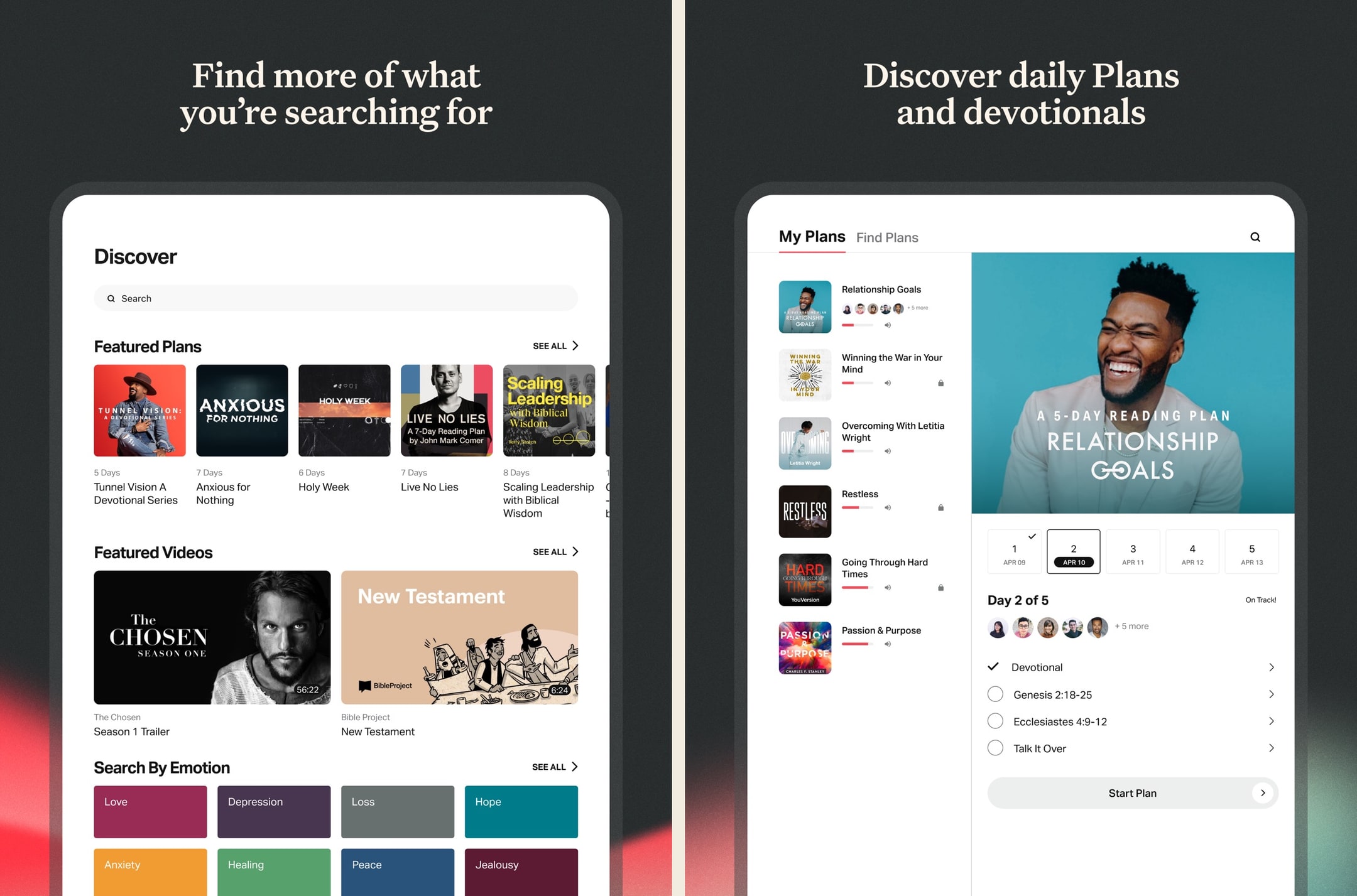
We've used YouVersion daily over an extended stretch and it's still the default for a reason: free, frictionless, and good enough for 80% of what most readers want. The reading plans alone keep us coming back, and the Apple Watch + widget integrations turn opening scripture into a one-tap habit. But the moment we wanted to do real study — cross-references, commentary, original Greek — we hit a wall and reached for a different app. As a primary daily-reading Bible, it's still the one to beat in 2026.
What we like
- By far the largest free Bible-reading app — 2,500+ translations including pretty much every English version anyone reads.
- Reading plans library is enormous and well-curated, ranging from 3-day devotional plans to year-long Bible-in-a-year tracks.
- Genuinely free with no ads, no paywalls, no premium tier hiding key features behind a subscription.
- Solid offline support — download translations locally and use them on a plane or in low-signal areas without losing functionality.
- Bible Lens / verse images make sharing scripture in iMessage and social posts effortless, which is a quiet but real driver of daily use.
What to know
- Study tools are thin — there's no commentary integration, no original-language word study, no concordance worth using.
- Notes feature is closer to a verse highlighter than a real notebook — you can't write longer reflections that anyone will ever go back and find.
- Search across your own highlights and notes is weak; finding a verse you saved six months ago is harder than it should be.
- Some reading plans are openly evangelistic about Life.Church positions, which won't bother most users but lands awkwardly for Catholic, Orthodox, or denominationally-cautious readers.
- App is feature-sprawling — every release adds something, and the home screen has slowly become a content feed instead of a Bible.
Best for
Anyone who wants a free, simple, mainstream Bible app for daily reading and reading plans on iPhone or Android.
Skip if
You want serious Bible study with commentary, original-language tools, or a real notebook — Logos or Olive Tree are stronger picks.
Enjoyable but a Few Considerations
I like to use the app to listen to the Scriptures. It is pretty to easy to use and so far on my end there were not glitches or issues. The app has a lot of different English versions to choose from as well I did notice that one can choose from many different languages. There are a variety of reading plans to choose from. One can select plans that are topical, reading plans, or based on length. For motivation there are verses of the day, guided Scriptures, and guided prayers. A remind notification can be setup. The app allows users to create a community by adding friends and family through Facebook or Contacts. Another feature is that the app allows for the notes and highlights. Please note that these items do not carry over from translation or language version. The app has an internal reward system through an achievement system. For example, completing a reading plan regardless of length. To help incentivize those who are multi language speakers I would like see achievements related to readings completed in different languages. To help incentivize multiple translations I would recommend adding achievements related to how many different translations a user read. Finally, I would like to see statistics on which chapters were read because sometimes a user will get a whole Bible reading plan completed twice within a plan because certain plans reuse certain passages. This will help those who want to have a nice clean progress between plans.
— Kolya290 · September 12, 2025
Why we're not on this list yet
Warmpeach is a Bible chat app that blends a pastor's care with a therapist's questions, grounding every reply in scripture. It is launching soon and is not on this list because we are not shipping yet. Adding ourselves to a rankings page before we have a public app would violate the methodology that makes everything else on this page worth reading. The reason Warmpeach exists is that the gap between today's Bible chat apps and what readers actually need is real — more pastoral than answer-driven, more therapist-shaped than chatbot-shaped, theologically grounded, with no aggressive paywall games. If that sounds like the app you have been waiting for, the waitlist is below. We will revisit this page once Warmpeach ships and let independent reviewers decide where it lands.
Join the Warmpeach waitlist →Verdict
Warmpeach — coming soon
A Bible chat app — pastor and therapist in one.
Warmpeach is a Bible chat app that blends a pastor's care with a therapist's questions, grounding every reply in scripture. Join the waitlist and we'll email you when it opens up.
Sources
-
Haven Bible Chat — App Store listing (pricing and in-app purchases section). Accessed 2026-05-08. https://apps.apple.com/us/app/haven-bible-chat/id6503387382
-
The Bible Chat — App Store listing (pricing, in-app purchases, "Panic Button" feature). Accessed 2026-05-08. https://apps.apple.com/us/app/bible-chat-daily-devotional/id6448849666
-
Grace: Bible Chat — App Store listing (pricing, developer "Pleasant Futures Corporation Limited", in-app purchases). Accessed 2026-05-08. https://apps.apple.com/us/app/grace-bible-chat/id6744955878
-
Hands-on testing notes captured during 2026-05 — verse-citation accuracy stress tests, paywall variants observed across multiple paywall serves, and crisis-prompt response patterns. Raw screenshots in our internal archive.