
Manna Review
By Sankalp Jonna · Last reviewed 2026-05
Get the app
How we tested
Every app here was installed and used personally. We capture raw findings — typed notes, screenshots, screen recordings, voice memos — and the writing is AI-assisted from those raw notes. Scores, rankings, and "best for / skip if" calls reflect our actual experience with each app. Read the full methodology →
Our verdict
We'd recommend Manna as a secondary pick for iOS users who've tried YouVersion or another full-featured Bible app and found the content feed counterproductive to actually reading. The deliberate minimalism is the actual product, and for habit-formation it's a meaningful difference. As the reading-plan layer alongside YouVersion (for the deeper Bible reader) or BibleProject (for literacy content), Manna fits cleanly into a focused study workflow. Skip Manna as a primary Bible app — that's not what it is. The plan library is small, there's no audio, no notes, and no notebook, and the indie scale means feature velocity is slower than mainstream Bible apps. For users who want a comprehensive Bible app, YouVersion is the cleaner pick. For Android users, there's no version of Manna available, and the closest spiritual equivalent is YouVersion's plan library used with discipline.
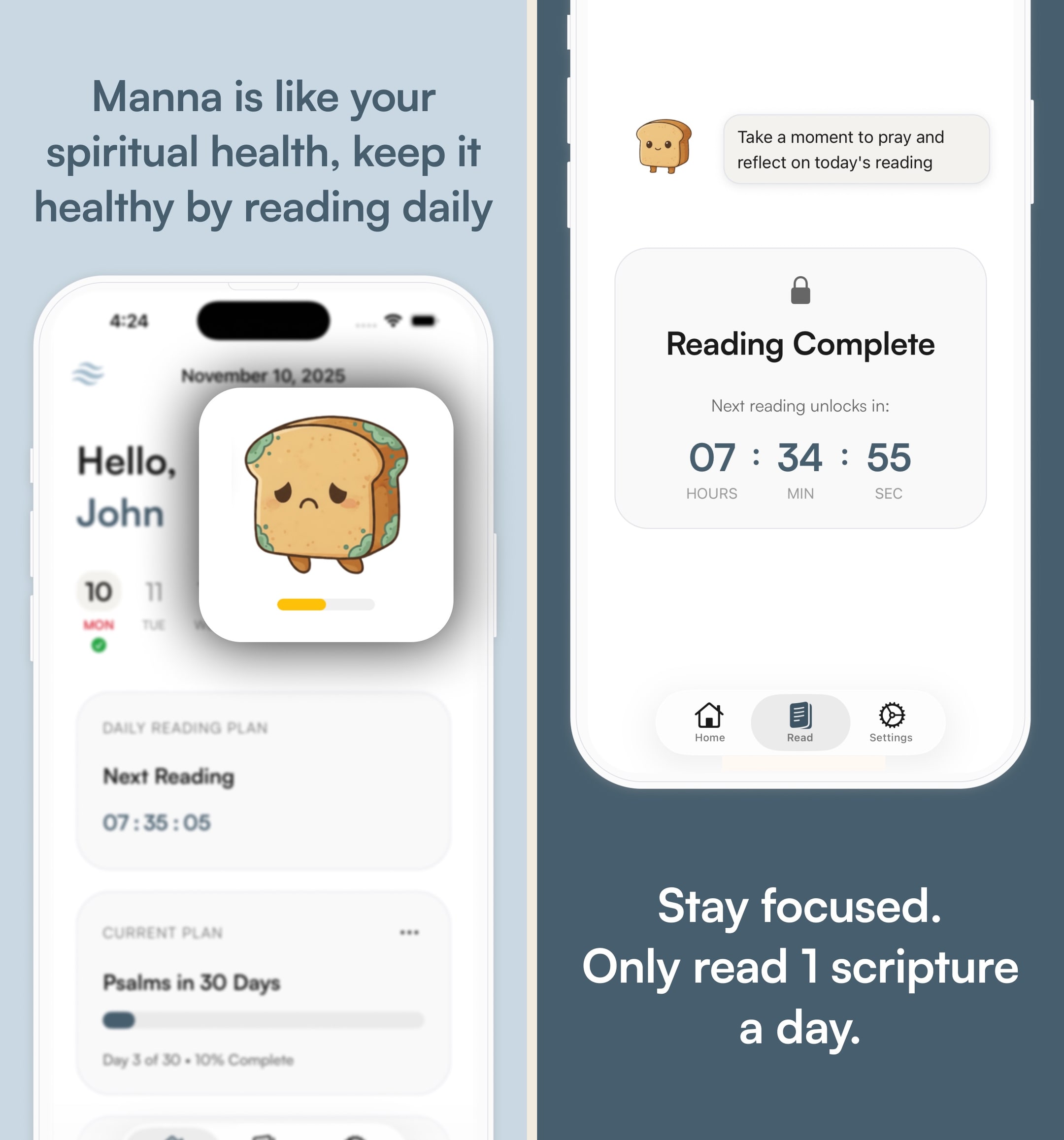
Setup and first run
Installing Manna is the closest a Bible app gets to feeling like a quiet utility. We installed it on iPhone and iPad and the onboarding asks for almost nothing — a translation preference, a notification time for the daily reminder, and an optional iCloud sign-in for cross-device sync. There's no email collection, no friend graph, no upsell-before-utility flow. Two minutes in, today's reading is on the home screen.
The first thing a new user notices is what isn't there. There's no content feed, no verse-of-the-day card, no friend activity, no algorithmic recommendation engine, no plan-of-the-week carousel pushing alternative content. The home screen shows today's reading, the streak counter, and a small button to mark the day as complete. For users who've internalized the busy shape of YouVersion's home screen, the silence is the actual product, and it takes about thirty seconds to recognize that the silence is intentional.
Day-to-day reading
The daily-reading loop is the experience. Open the app, read today's passage in the chosen translation, mark the day complete, close the app. We worked through a multi-week reading plan during testing and the rhythm held — sessions land at whatever length the day's passage requires (anywhere from five to fifteen minutes depending on the chapter), the plan engine forgives missed days without breaking the streak, and the close-the-app friction is genuinely zero.
The plan-tracking is the second feature that earns its keep. Manna ships a small library of well-curated reading plans rather than YouVersion's thousands of options — most are book-by-book or testament walks rather than topical devotionals — and the plan engine handles missed days the right way. Catch up cleanly without backfilling guilt; the streak counter is present but doesn't punish you for it.
The deliberate minimalism
Worth a separate mention. Most Bible apps in 2026 are fighting for engagement — content feeds, social features, notification cadences — and the side effect is that the actual reading experience competes with the engagement layer. Manna inverts that. There's no engagement layer to fight; the app exists to put today's passage in front of you and get out of the way. We noticed during testing that we read more carefully in Manna than in YouVersion, and we'd guess it's because the app gives us nothing else to do. The constraint is the product, and the product is meaningfully better for it.
Where it surprised us
The plan curation is better than we expected for an indie app. We assumed the small plan library would be a thin selection of generic plans; instead the available plans are well-curated — book-by-book walks, chronological New Testament reads, gospel-by-gospel comparisons. The library isn't deep, but the plans that are there are thoughtfully chosen rather than indiscriminately compiled.
The honesty of the pricing model is the second surprise. Manna is genuinely free with an optional tip jar, and there's no freemium paywall, no premium tier, no ads, and no engagement-extraction loop. For an indie app, the developer being clear about the funding model — 'this is free, you can tip if you want' — is a meaningful trust signal that contrasts with most paid Christian apps in 2026.
Where it disappointed
iOS-only is the structural limit. There's no Android version, and the developer hasn't publicly committed to building one. For Android users wanting a similar minimal-reading experience, there's no equivalent product in the category, and the closest workaround is YouVersion used with intentional discipline to ignore the home feed.
The feature surface is intentionally narrow and that's a real cost in some workflows. There's no notebook, no audio Bible, no devotional content, no social features, no group-reading workflow. For users who want their Bible app to also be their study tool, their devotional reader, or their community space, Manna doesn't, and the workflow becomes multiple apps. The narrow scope is the design choice, not a flaw, but it's worth being clear about.
The single-developer scale shows in feature velocity. Manna launched in 2025, the update cadence in the first year has been reasonable, and bugs have been fixed — but the velocity is necessarily slower than YouVersion or Olive Tree.¹ Feature requests don't make it into the next release the way they would on a larger team, and the long-term update path depends on the indie developer continuing to support the app. For users committing to Manna as a primary daily-reading tool, this is a real consideration.
The reading-plan library is smaller than YouVersion's by orders of magnitude. YouVersion ships thousands of plans, including topical, devotional, and book-by-book content from many publishers; Manna ships a few dozen well-curated plans. For users who want plan variety, the library is the limit. For users who want a curated selection, the smaller library is fine.
The pricing reality
There isn't one to negotiate. Manna is free with an optional one-time Supporter tip starting at $2.99.¹ There's no freemium paywall, no premium tier, no recurring subscription. For users who appreciate the indie-developer model, the tip jar is the right way to support continued development; for users who just want to use the app, free is fine and there's no functional difference.
The honest counterargument is that 'free with an optional tip' doesn't necessarily mean 'sustainable long-term.' Indie apps with no recurring revenue stream are vulnerable to the developer eventually losing motivation or income to keep maintaining the app. Manna is a 2025 launch, and the first year has been steady, but the long-term update path depends on the developer's continued investment. Users committing to the app should watch the update history.
All paid plans visible on the Manna: Bible Reading Plan App Store listing. Free trials and intro pricing may vary by region.
Monthly
- Manna Premium - Monthly$4.99
Yearly
- Manna Premium - Yearly$19.99
- Manna Premium - Yearly (Standard)$29.99
Who else should consider it
Bible-app users who've tried YouVersion and found themselves scrolling the home feed instead of actually reading are the second audience after minimalism enthusiasts. The deliberate restraint is the explicit fix for that failure mode, and we've talked to multiple users who switched to Manna for exactly that reason.
iOS users in seasons of life with limited time — new parents, intense work seasons, caregiving for elderly relatives — fit the audience well. The 'no decision, just today's reading' shape removes the decision fatigue that plan-shopping creates, and the streak-without-nagging removes the guilt cycle that habit apps can produce.
Bible-study leaders running short, focused reading plans with small groups can use Manna's clean plan-tracking as the shared rhythm. The app doesn't ship a real group-reading workflow, but a leader can run the same plan and use a separate group chat for discussion, with Manna as the just-the-passage tool.
Our final word
Manna in 2026 is the indie reading-plan app that does one thing on purpose, and the deliberate minimalism is the actual unlock. For iOS users who want a focused habit-formation tool without YouVersion's content feed, this is the cleanest pick we've tested.² The constraints are honest — iOS-only, intentionally narrow, indie-scale update cadence — and the app isn't trying to be a comprehensive Bible reader. As the daily-reading layer alongside YouVersion or BibleProject, Manna fits a focused study workflow cleanly. Watch the developer's update cadence; if it stays steady, this could be the indie habit app of the next several years.
Alternatives we considered
Compare Manna: Bible Reading Plan to other Bible apps
Warmpeach — coming soon
A Bible chat app — pastor and therapist in one.
Warmpeach is a Bible chat app that blends a pastor's care with a therapist's questions, grounding every reply in scripture. Join the waitlist and we'll email you when it opens up.
Sources
-
Manna: Bible Reading Plan — App Store listing (free with optional Supporter tip, iOS-only, 2025 launch). Accessed 2026-05-11. https://apps.apple.com/us/app/manna-bible-reading-plan/id6754670932
-
Hands-on testing notes captured during 2026-05 — multi-week evaluation of Manna's reading plan engine, streak tracking, and minimal home screen on iPhone and iPad. Raw screenshots in our internal archive.